MONROE, CT — Tragic stories of a fiery crash involving an impaired driver and of an overdose in front of family members, and cautionary tales of criminal and legal liability for those hosting parties with underage drinking were an appeal for parents to “have the conversation” with their kids about underage drinking and substance abuse, and to Masuk High School freshmen to make good decisions.
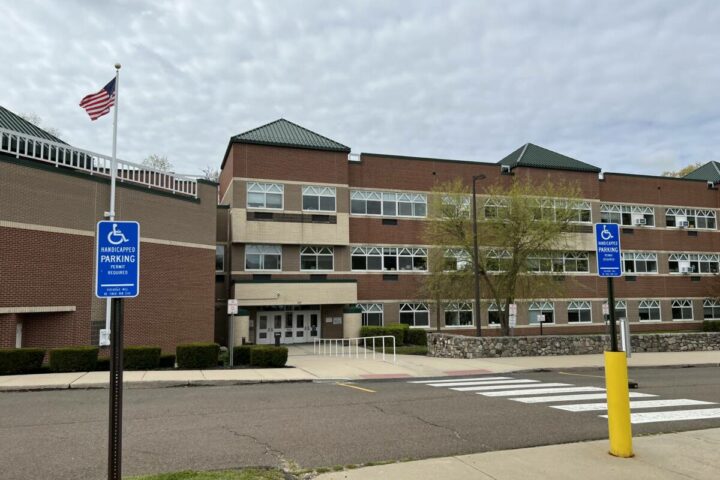
Masuk and Alcohol and Drug Awareness of Monroe (ADAM) hosted the annual Forum on Underage Drinking and Substance Abuse: Have the Conversation in the school auditorium last Thursday night.
Parents received folders with helpful resources and attendance cards for their kids and were encouraged to fill out feedback forms at the end of the presentations.
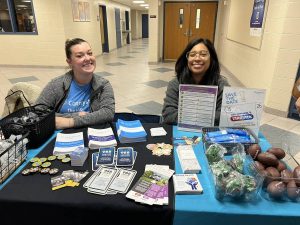
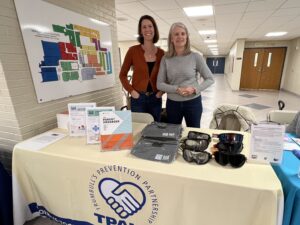
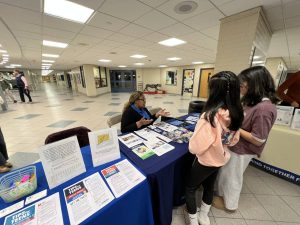
During the forum, volunteers in the school lobby sat at booths representing organizations like The Hub at Catalyst CT, TPAUD (Trumbull’s Prevention Partnership) and FAVOR Inc., as well as at a Town of Monroe table.
Superintendent Joseph Kobza said the forum is part of the freshmen health class curriculum. Kobza told students the featured speakers were participating, because they care about them and want them to be safe.
“You might think, ‘that will never happen to me,'” Kobza told the audience. “I’ve seen it over the years. The accidents, the sexual assaults.” Aside from his role as superintendent, Kobza, a former Masuk principal, said he was also speaking as a parent.
“Have the conversation,” he urged other parents. “They’re difficult sometimes and they’re uncomfortable.” But Kobza said his two daughters felt relief after having it.
High school can be about memorable events like big games, dances and musicals, but Masuk Assistant Principal Ian Lowell said, “tonight is really building the foundation of something more important than these things: our children’s public safety.”
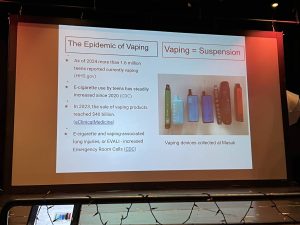
Lowell talked about the epidemic of vaping among teenagers. As of 2024, he said more than 1.6 million teens reported they were currently vaping. He said it has grown to become a $40 billion business.
Vapes use liquids with vitamin E, which Lowell said sticks to the lungs, and has chemicals like propylene glycol and formaldehyde, and heavy metals like nickel, lead and cadmium.
He said the industry markets directly to teenagers with flavors like blue raspberry.
“It goes without saying that you don’t want it in your body,” Lowell said. “It’s as bad or worse than cigarettes.”
He said THC and marijuana used with vape cartridges carry significantly more potent doses than smoking leaf marijuana. The worst outcome is when it causes a psychotic break that can lead to cycle vomiting, hospitalization and sometimes death.
Lowell encouraged students to avoid friends who use these drugs, which could put them on the road to life-altering consequences, including school suspensions.
He remembers sitting across from students in his office, pleading with him that it was only one time, that they’d miss a big game or their parents would ground them for life. “It breaks my heart,” Lowell said.
Monroe Youth Detective Stacy Cascante went over laws for the procurement or possession of alcohol by a minor, which she said is anyone under the age of 21. Consequences for violations could lead to fines and or suspended or delayed issuance of driver’s licenses.
Cascante said a driver as young as 16 could be tried as an adult for a DUI arrest and a juvenile summons would be issued for a driver who is age 15 or younger.
Monroe’s police officers work with state officials to do compliance checks at liquor stores and smoke shops to crackdown on any who sell alcohol, tobacco, nicotine or vaping products to customers under age 21.
A storeowner is fined $300 for a first violation, $750 for a second violation and $1,000 for any subsequent violations within 24 months, according to Cascante, who said a store with enough repeat violations could be fined as much as $10,000.
Cascante encouraged anyone who knows of a business in town that is selling to minors to tell police about it.
She said minors could also get in trouble for misrepresenting their age as 21 or older.
 “Parents, you would be amazed at what some kids do,” Cascante said of efforts to get vaping products, adding some barter with adults, giving them pictures and videos of themselves in exchange for them buying it for them.
She also said possession of marijuana under age 21 is illegal.
“Make good decisions and encourage your friends to do the same,” Cascante said.
If a friend overdoses or has alcohol poisoning at a party, Cascante said not to be afraid of getting into trouble, because making a 9-1-1 call could save their friend’s life.
Cascante also warned parents of the consequences of hosting laws. “Don’t host,” she said of having parties with underage drinking, “and encourage other parents not to either.”
The ultimate price
Erin, a mother who lost her 23-year-old son Kyle in a fiery crash when another driver was high in 2018, shared her tragic story as a cautionary tale of how driving impaired can put yourself and others at risk.
She showed family photos set to music, memories of her son growing up, playing baseball, fishing, his graduation, going out with his girlfriend and having fun with friends.
“Maybe you see a little of yourself in that video,” Erin said. “My son was killed by an impaired driver. The message is clear: Don’t get in a car with someone who drank, had edibles … I’m a mother against drunk driving.”
Erin urged students not to drink or use drugs and drive or to get into a car with a driver who is impaired, even a parent.
“There is no accident with impaired driving. It’s a crash,” she said. “A police officer told me my son was in the wrong place at the wrong time. Half of all teen deaths are in car crashes.”
In the next photo Erin showed, pieces of a Chevrolet Malibu were strewn among the wreckage in the roadway. “This is the woman who hit my son’s car,” she said.
The woman and her 40-year-old passenger were high on marijuana laced with PCP. Erin said her car weaved in and out of traffic, leaving the road several times — at one time hitting a utility pole and somehow getting back on the road.
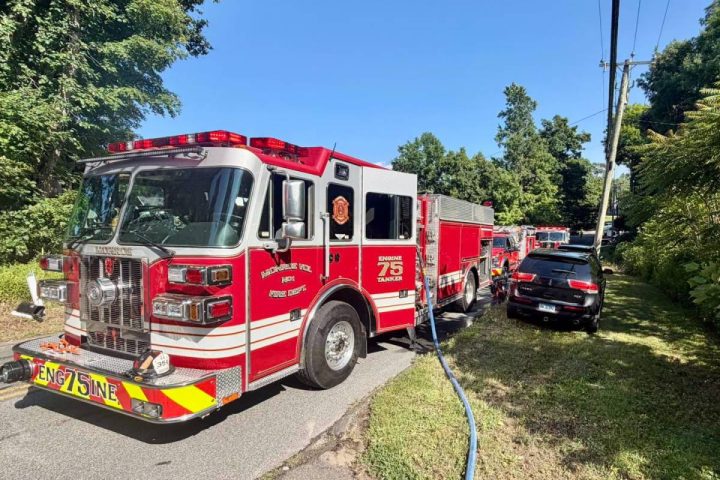
A billowing cloud of black smoke rose above the tree line along the roadway in a news video. The newscaster’s voice said, “there’s a dead person on the road after a head-on collision.” The grim scene included fire trucks, police cars and other emergency vehicles with flashing strobe lights.
“You may think nothing like this is going to happen to you,” Erin said. “So did I. My son was picking up Chinese food for his girlfriend.”
Kyle drove around a blind corner and suddenly saw the woman coming right at him in her Malibu. He rode along the guardrail to his right in a vain attempt to avoid a collision, just before the head-on crash, according to his mother.
Erin said her son was driving 55 to 60 mph and the woman was driving between 110 and 116 mph. When you add the speed together, she said it was about a 175 mph collision.
“My son survived. We were told he was the most savable,” she said.
She said the driver of the Malibu was thrown from her car on impact and died in the roadway. Her passenger briefly survived the crash before succumbing to a serious neck injury.
Erin’s son was alive, but his legs were trapped beneath the engine of his vehicle. A firefighter and a paramedic tried to pull him free, but had to stop and leave him there to burn to death after a gas explosion.
“He filled the tank with gas that morning,” Erin said of the fuel feeding the blaze firefighters had trouble extinguishing.
“Unfortunately, it’s something I live with every day,” she said.
She said Connecticut is consistently among the top five states in the nation with the most impaired driving crashes.
“We have to do better, because behind each person is a name, gender, birth date, career of a person who is loved by a family that is grieving and broken with nowhere to turn,” Erin said. “The death of a child changes everything — the past, the present, the future. Imagine your parents getting that call. It’s a life sentence. I have to live alongside it. We share the story of Kyle to prevent other tragedies.”
She encouraged students to come up with a code with a loved one who could pick them up when they are in trouble or to call an Uber when they should not drive. She also urged them to be true to themselves and not to turn to substances to avoid struggles, which are a part of life.
The last photo she showed was a message in a fortune cookie her son had saved, which said, “life is a gift. Don’t waste it.”
No one is immune
Opioid addiction affects the lives of millions of people in all demographics, even Monroe Police Officer Brooke Larsen, a Masuk graduate who is currently the high school’s resource officer has had to deal with its consequences.
“My brother is a heroin and meth addict,” she told the audience. “He was only two years older than me and went to Masuk, where he was a rising baseball star. He had a girlfriend and friends. Some would say he had it all.”
But Larsen said her brother tried something at a party, became an addict and quit the baseball team. On June of 2021, he almost became one of the approximately 20 Monroe residents to die of an overdose, but Larsen said a friend had Narcan and saved his life.
Then Larsen asked students to imagine themselves performing CPR and giving rounds of Narcan to one of their friends as her family cries out for them to save her. But the friend dies just as a school bus pulls up and her eight-year-old daughter steps off it.
Her grandfather falls to his knees and tells the little girl, “mommy’s dead.”
“As a police officer, I responded to this call and pumped on my friend’s chest,” Larsen said. “She was my best friend at Jockey Hollow and I couldn’t save her. Imagine, one person used and the whole family suffered.”
The cool defendant
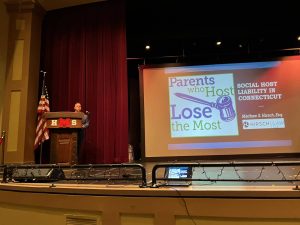
Attorney Matthew Hirsch, of Hirsch Law LLC, is a Monroe resident of 25 years. He and his wife raised their three daughters in town, where he is an advocate for prevention education in the school community. Hirsch delivered a sobering message of the potential consequences for social hosting with underage drinking.
“What I’m about to say should scare the heck out of you,” Hirsch said. “And what I’m about to say should not be dismissed as, ‘hey, this never happens to parents’ — because it does, and quite often at that.”
He said a large part of his practice involves cases in which an innocent person was catastrophically injured or killed by underage drinkers leaving a party at someone’s house.
Hirsch said people often think social hosting laws only apply when parents host a party with underage drinking at their homes, supply the alcohol and are aware that someone is impaired.
“It is so much more than that and your risk and financial exposure is so much more than that,” he said.
Hirsch said there are two systems of justice: criminal and civil, which is less about justice and more about compensating people for injuries from wrongs done to them.
“And when it comes to social hosting, for parents it is 10 times broader and the risk and exposure to you is 10 times greater,” Hirsch said.
He said parents are at risk, even if minors consumed alcohol prior to coming to their home.
Hirsch said there are examples of obvious fault with social hosting that most could agree on, such as the case of Ely vs. Murphy, when parents hosted a graduation party for their son, told him to invite the entire senior class of over 400 kids, and the father bought 12 half-kegs of beer.
At 3:30 a.m., one kid leaving the party got into his car and ran over and killed another party goer.
But Hirsch said other scenarios also open parents up to major risk, including cases when they say their kid can only have three friends over and more show up, or that everyone must sleep over, they take the minors’ keys, or someone else brings alcohol.
One minor who keeps his keys and leaves, drives drunk and crashes into a vehicle with a family coming home from a show. Then people on social media post comments about how the minor was at a party with underage drinking at your house earlier in the evening, Hirsch said.
Lawyers for the plaintiffs can’t get a subpoena like police officers to make party goers talk to them, so they file a lawsuit against you to seek answers to their questions. It’s going to take three years before you can explain your side of the story to a jury, according to Hirsch.
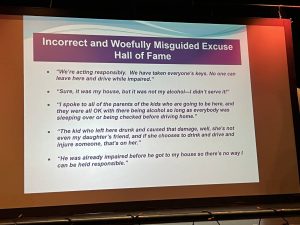 He listed common excuses parents give, then mentioned how easily it falls apart. For example, a parent could say, “we acted responsibly and took everyone’s keys, so no one could leave and drive impaired.”
“Sure that seems like a very reasonable thing to do, but to us defense attorneys that is gold — you are admitting that you know alcohol is being consumed by minors on your property,” Hirsch said.
Hirsch said someone hosting a party with underage drinking suddenly goes from being the “cool parent” to the “cool defendant.”
Trauma for health care workers
Shannon Spaulding, EMS coordinator and program manager for Hartford Healthcare at St. Vincent’s Medical Center, told students about the worst emergency calls for her and other health care workers.
“Your brain is not fully developed until you are 25,” she said. “You’re all hardwired to make terrible decisions. We’re at places where you made a terrible decision and we hope we can send you home.”
Spaulding said driving impaired or not calling 9-1-1 when a friend tries to drive while intoxicated can lead to, not only traumatic experiences for yourself, other drivers, families and friends, but also to the first responders and health care workers who try to save lives.
“‘I’m very sorry. We did all we could, but your child is dead.’ I remember all the parents’ faces,” she said of delivering bad news after a DUI crash. “We always think of what we did wrong or could have done to save you. It stays with us.”
Spaulding said teenagers should work out a plan with a trusted guardian to call for a safe ride home with no questions asked and no consequences — at that moment.
“I care about you guys,” she said. “We care about people as EMS providers. Every time we lose a person, we carry it with us.”
Positivity
Susan Clark, a Masuk graduate, social studies teacher and faculty advisor for SADD (Students Against Drunk Driving) invited students to join the club.
Ann Odoy, a Masuk graduate and a school counselor of 23 years, told the freshmen students how special they are and encouraged them to surround themselves with positive people.
“We all make mistakes. Make better decisions,” she said. “Turn to positivity. Turn to people who can help you along the way. Sometimes it’s okay to be alone or be with your families. It’s okay to say no.”
Jessica Champagne, a licensed clinical social worker for the school district, gave parents advice on how to “have the conversation” with their kids.
“Be open and approachable about the little things, or they won’t come to you with the big things,” she said.
Champagne said the biggest barrier is teenagers’ fear of being judged, so avoid making closed judgements about their character.
For instance: “You’re really lying to me right now” is not a pleasant thing to say but is better than saying, “You’re such a liar.”
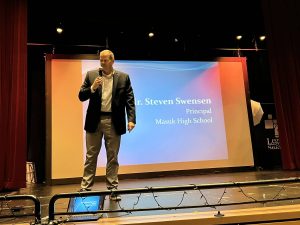
Principal Steve Swensen said parents should make an effort to know who their kid’s friends are, and they can reach out to Masuk’s guidance counselors for entry points if they are unsure of how to start “the conversation” with their kids.
“I think the message to take with you is everyone in this community cares for your well being,” Swensen said to the freshmen class. “We didn’t do this to inconvenience you on your Thursday night. We did it because we care.”
All respectful comments with the commenter’s first and last name are welcome.