

MONROE, CT — Masuk High School juniors Brady Ebner and Zoey Estevez suddenly found themselves in the “real world” Tuesday morning. Ebner landed a job as a Realtor and Estevez as a mechanical engineer.
The friends were participating in Reality Check, the Rotary Club of Monroe’s annual simulation in the Masuk gym, in which students in personal finance teachers’ Jonelle DiSette and Allyson Danso’s classes try to pay for life’s necessities, and some leisure, while balancing their household budgets.
“I think I’ll focus on the necessities first, then focus on things I enjoy,” Ebner said.
“I think I’ll be the same way — focus on my necessities,” Estevez said. “Without a budget, you don’t know what you need to spend on. I like to buy stupid things. I’m a collector. I’ll try to be as conservative as I can with my spending.”
Estevez likes to collect figurines and plushies (stuffed animals).
“It can get expensive,” she said, “especially limited edition.”
The Masuk gym was broken up into stations manned by adult volunteers, including transportation, housing, finance, medical, routine living expenses, side hustle, credit card and discretionary spending.
Ebner and Estevez considered the options.
“I definitely need to sleep somewhere, so definitely housing first,” Estevez said.
“Maybe we could be roommates,” Ebner suggested.
Reality Check also includes a Wheel of (Mis)fortune to mimic life’s unpredictable moments. For instance, a fender-bender can lead to costly repairs making one’s budget take a hit that was unplanned for.
On the flip side, an inheritance or winning lottery ticket could provide a financial boost.
From Oklahoma to Monroe
Dave Wolfe, a Rotary Club member, modeled Reality Check after a program at the Yukon Public Schools in Oklahoma. He proposed offering the program at Masuk with the support of Superintendent Joseph Kobza, a fellow Rotarian who embraced the idea.
This year marked Masuk’s fourth annual Reality Check.
“The teachers integrated it with their curriculum,” Wolfe said, adding the exercise allows students to learn in a setting, where mistakes can happen without real life consequences.
“I think we kind of got our routine going,” said Monroe Rotary Club President Ken Kellogg. “We’ve been flooded with questions from other clubs in Connecticut, who want to do it in their communities, like Trumbull.”
Kellogg said they are always looking for ways to improve upon the format.
Beth Stoller, a member of both the Monroe and Trumbull Chambers of Commerce, volunteered for Reality Check at Masuk and loved the concept.
“I took it directly from Dave,” Stoller said. “I was president of the Trumbull Rotary three years ago.”
That’s when the Trumbull Rotary Club brought Reality Check to their high school.
Kobza said the program cannot be possible without volunteers. On Tuesday, 47 professionals and town officials participated. A total of about 160 students came to the gym in two waves.
“We couldn’t have done this without Dave Wolfe,” Kobza said. “It’s important for our kids to get a dose of reality with a Reality Check.”
A condo in Fairfield

Ebner’s real estate agent salary was $63,000 a year with a monthly paycheck of $5,250. But FICA ($325.50), Medicare ($76.13), federal tax ($846.49), state tax ($262.50) and Family Leave tax ($26) reduced his take home pay to $3,713.13.
As a mechanical engineer, Estevez earned a $59,325 salary with a $4,943.75 monthly paycheck. Deductions took it down to $3,520.65.
The goal of Reality Check is to make it around the room with no debt or, even better, some money left over.
While looking for housing, potential destinations were in Monroe, Fairfield or Shelton.
Ebner reasoned that living in the most expensive town would place them near more opportunities for higher paying jobs, and Estevez wanted to be close to a train station.
Fairfield checked both boxes. A condo there came with a monthly rent of $1,705.50 each.

“We’re living together, so we can get one car and split the cost,” Ebner said.
“Let’s get medical first, so we don’t die,” Estevez said with a laugh.
They invested in health insurance with a $65 co-pay. Danielle Paolozzi, a volunteer from M&T Bank, told them they should start thinking about insurance when they are 25, and possibly apply for a plan with savings if they are not yet employed.
Cellphones, streaming
Next Estevez and Ebner chose a package with a cellphone, Apple TV, Netflix, a 50gb high-speed mobile hotspot and auto pay. At $90 a month, it was the second most expensive plan.
“Home entertainment is definitely cheaper than going to the movies all the time,” Ebner reasoned.
Both decided to shop at a regular supermarket, rather than a more expensive health food store. The difference was $336 a month rather than $412.
“We think we can be healthier with decisions on regular food,” Ebner said.
“I only did entertainment and food,” Estevez said of her routine living expenses. “I don’t get my hair done often or get my nails done.”
She spent $426 and Ebner spent $502.35.
“I had to get a haircut every month and budget money for iced coffee at Starbucks, nine coffees a month,” he said.
The $3,520 Estevez started out with had already dwindled down to $1,324. “I spent a lot and have a few booths left,” she said. “I’m starting to feel a little nervous.”
Estevez said it made her realize how precise you have to be when budgeting, and she thought of potential conflicts at home when children want things.
“I think I want to get a job this summer and learn how to budget my money,” she said.
Interest adds up
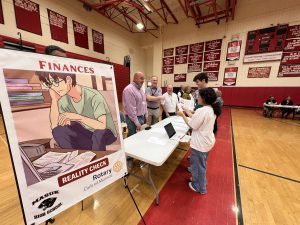 Ebner and Estevez stopped at Rotaryville Credit Services to figure out how to manage their credit cards and maintain a high credit rating, allowing them to borrow at lower interest rates.
“What do you know about finances?” Frank Dutches, who is the town treasurer, asked.
“It helps your credit if you do it well and you pay it off at the end of the month,” Estevez replied.
Dutches said paying off a loan is the best thing, but unanticipated expenses like car repairs could prevent you from doing that.
The students were presented with three options to borrow $1,200. In Option 1, they could pay $38 a month for 53 months, adding $776.81 interest for the life of the loan, bringing the total payment to $1,976.81.
In Option 2, they could pay $120 a month for 12 months with a total of $159.86 interest. The total obligation would come to $1,359.86.
Option 3 involves paying off the entire $1,200 loan at the end of the month with zero interest.
“Make sure you know what the interest rate is,” Dutches said of borrowing. “After you’re done, you have to look at the money you have left and pick a payment option.”
Retirement, a Nissan Versa
Though Ebner and Estevez were only embarking on their first month in the work world, it’s never too early to start saving for retirement.
William Holsworth, the town’s economic and community development director, went over two scenarios.
Setting aside $200 a month from age 25 to 65 with a seven percent average rate of return would total $96,000 in deposits over 40 years. Growth would be $401,101 for a total portfolio value of $497,301 by retirement.
A more expensive plan entails depositing $400 a month, for $192,000 in total contributions and $802,206 growth for a nest egg of $994,606 by retirement.
“If we have a higher surplus of money, we’ll go with the higher savings plan,” Ebner said of the end of the month.

Ebner ended up investing in the higher savings plan, while Estevez had to go with the lower one. But she was determined to improve her financial situation, so she could upgrade to the higher plan.
At the transportation booth, Estevez noted how they lived near the train station. But volunteer, JoAnne Amonte, of M&T Bank, told her they would still need a car to get around town.
Estevez didn’t want to buy an expensive car, so Amonte sold her on a Nissan Versa for $17,000.
Estevez’s 700 credit score resulted in a $301 monthly payment and her monthly operating cost was $264 for a total of $565.
Taking a spin
It was time for Ebner to try his luck at the Wheel of (Mis)fortune:
Ouch! He was hit with $300 in computer repairs.
Now, it was Estevez’s turn:
Estevez also had an unanticipated expense. Hers was $350.
“I didn’t want to go on a trip, but at least I got Disney out of it,” she said. “I have $400 left. I need a cheap retirement now.”
Ebner had $575 left.
Discretionary spending
It was time to choose at least one entertainment option from a list.
Estevez chose the $150 entertainment option, dinner for two and a movie at AMC Trumbull. She had $59 left after spending $200 for her retirement savings plan.
Ebner invested in the $400 retirement plan, leaving $25.28 at the end of the month.
“It did seem like a lot of money,” Ebner said of the $3,713.13 he started out with. “But it’s crazy that at the end I only have $25. It can go to savings for emergencies. I’m glad I have $25 left. It’s a healthy amount I can save.”
“I feel now I just want to get a better job,” Estevez said. “I want a better retirement plan.”
“We’re not living in a dump. We’re in Fairfield,” Ebner said. “Even if you’re not a millionaire, you can still have a comfortable lifestyle if you have a healthy budget and you don’t splurge on the non-necessities.”
All respectful comments with the commenter’s first and last name are welcome.






It seems some important necessary expenses were left out of what the two students “entry to the real world” encountered,
No mention of insurance -beyond medical, home owners (even for renters), auto, dental, Rx.
Nothing for electricity, heat, water, lunch, gasoline, TV, clothes, computer and software, parking, maintenance of auto, appliances
Nor others that normally occur, like medical devices, supplies for appartment, medicines, Se urity deposit (even though refunded at lease end), and more.
i think that should done at every school at least once a yr. starting at 8th grade. but they could have went with less expensive items like cheaper housing and car so they could save for emergencies.