MONROE, CT — How does Monroe work? Stepney Elementary School first graders went on a field trip to find out. During a visit to Town Hall Friday morning, the children met First Selectman Terry Rooney, Police Chief Keith White, Fire Marshal William Davin, and Edith Wheeler Memorial Library Director Nicole Cignoli and her staff.
Jamie Sherry, the elementary school leader for social studies for Monroe Public Schools, organizes the program, in which every first grader in the district, including Fawn Hollow and Monroe elementary schools, will go on the field trip.
“You are studying the town of Monroe,” Sherry told Stepney first graders seated in the Council Chambers of Town Hall with their teachers. “You are going to hear from some of the most amazing town helpers today.”
Sherry told The Sun the district’s social studies curriculum includes My School and My Community, in which students learn about all the town of Monroe community helpers, including the food pantry and parks and recreation. The lessons learned throughout the year culminate in a “real world” experience like Stepney students had Friday.
“You can definitely see the connections between what the kids learned about and the people in these roles,” Sherry said of the field trip.
The program was started by Ian Lowell, who currently serves as an assistant principal at Masuk High School, according to Sherry.
Police Chief Keith White
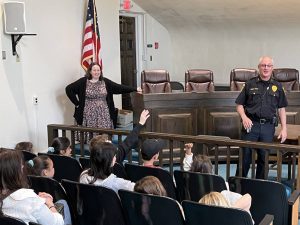
Monroe Police Chief Keith White greeted the children from the podium. “We’re going to talk about emergencies today,” he said.
White asked the students if they knew about the important phone number 911, and when you should call it.
One boy said for crime and the chief told him he was right. Others correctly answered for medical emergencies and fires.
“When you call 911, it goes to the dispatcher and they decide to send fire, police or an ambulance,” White said of the police station at the lower level of Town Hall.
“If you accidentally call 911, should you hang up?” he asked.
“No,” the children answered.
White agreed, saying the right thing to do is to stay on the line and say, “I’m sorry. I didn’t mean to call 911.”
“If you don’t do that, we’ll be coming with lights and sirens,” the chief said.
“If your father falls off a ladder, do you call 911?” White asked. When a child said yes, the chief agreed saying the father could have broken his arm.
“Who do you think they send first?” White asked about dispatchers handling the call. One boy correctly answered police.
“Yes, in Monroe police are part of the medical response,” he said, explaining how officers have medical supplies and training.
White said the dispatchers have a giant map on their screens, which shows where phone calls are coming from. If it is from a cellphone there is a radius.
First Selectman Terry Rooney
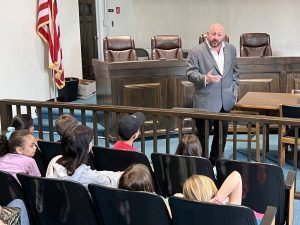
First Selectman Terry Rooney asked the first graders if they knew what he does and one replied, “you run the town?”
“Yes, I run the town,” he said. “The majority of the people in town elected me. I make sure the parks are healthy and clean, that the police department runs well, that the fire departments have the equipment they need, and that roads will be maintained.”
Rooney said he listens to a lot of opinions and input from others, while working together to make decisions.
As first selectman, Rooney told the children he has to think fast on his feet and make good decisions quickly. “Sometimes things happen out of the blue,” he said.
During a question and answer period, one boy said he wanted to know more about the police chief. Rooney told his young audience that he used to be a police officer too, and he praised the job White does as chief.
“Were you the first first selectman?” one student asked.
Not being that old, Rooney laughed and said there were many town leaders before him since the town was incorporated in 1823. However, he shared that two of his ancestors, Charles Blakeman, who was a first selectman in the 1850s, and Phillip Blakeman previously served in the position.
One student asked Rooney is he’s “the boss.”
“Everybody around me is pretty much my boss and I listen to all of them,” Rooney said of the electorate.
The first selectman asked the first graders, by a show of hands, who would vote for him if they could, and was pleased with their overwhelming support.
Fire Marshal William Davin
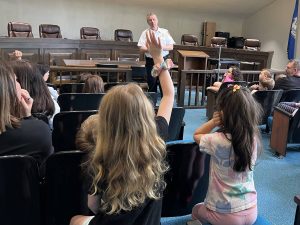
Fire Marshal William Davin told the children how he inspects buildings to make sure doors work and fire exits are clear, so conditions are safe in the event of a fire or another emergency.
“What do you do when a smoke detector goes off?” Davin asked, before pressing the button of a detector in his hand, causing a high pitched beep.
At school, students and faculty walk outside to safety, he said, before asking, “what do you do at home when the fire alarm goes off? Maybe you should meet by a tree or a swing set. It’s important to have a meeting place.”
But he said families shouldn’t meet too close to the street, because firefighters will need room when they show up in their big, red fire trucks. Davin said they have masks and tanks on their backs that allow them to go into danger.
“Does anybody toast marshmallows?” he asked. “Where does the smoke go? Up.”
If there’s a fire in one’s house or garage, Davin said the smoke rises up to the ceiling and across, adding that’s why smoke detectors are placed on ceilings.
He said firefighters stay low where there is less heat, it’s easier to breathe and there’s more visibility. Thermal imaging cameras help them identify the hottest spots and likely origin of the fire.
If there’s a house fire at 2 a.m., Davin said parents can hopefully come get their children out of their beds, but if they can’t, he said children should touch their doors. If a door is hot, fire is on the other side.
Davin said going out their window is an option. “It’s better to climb out your window and maybe break a leg or an arm,” he said of escaping to safety. “Fire doesn’t care who you are. It’s terrible and you could get killed.”
He said firefighters have ladders they can use to get children to safety. Because it’s safer to stay low during a fire, Davin said, “sometimes the best way to get out is to crawl.
Davin said there’s “good fire” and “bad fire.” Examples of good fires are a campfire under control and a wood burning stove that keeps you warm, while some bad fires are on a wall or a car fire, he said.
During a question and answer period, one little girl’s question sounded more like a statement. She said, “a campfire is a good fire, because you can make food like S’mores.”
“I always get it on my shirt,” Davin said of the marshmallows. “It’s sticky.”
Behind the scenes
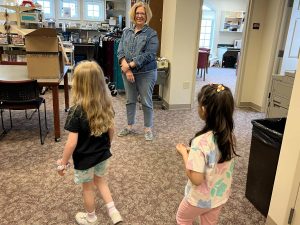
The last stop on the first graders’ tour was Edith Wheeler Memorial Library, where they met Director Nicole Cignoli and her staff.
There they learned the library’s role in the community and, by the end of the day, everyone had a library card. Sherry said this exposure to the library comes before librarians come to the schools to talk about summer reading.
At the library Friday, the children got to see the back offices. One adult told them not to tell anyone about it, because then they’ll want to go back there too. “Only you guys can see how the library works in the back,” she said of the privilege.
Every student who did a good job of behaving on their field trip received a sticker on their way to the buses.
All respectful comments with the commenter’s first and last name are welcome.