MONROE, Conn. — Stepney Elementary School first graders learned what the first selectman does, how town police officers work around the clock responding to emergencies, how smoke detectors and a safe meeting place can keep families safe from house fires, and about the lengthy list of free benefits a library card can give them during a tour of Monroe Town Hall and Edith Wheeler Memorial Library Friday.
Every year, Monroe’s three elementary schools take the tour on the first three Fridays of May to learn about community helpers, according to Jamie Sherry, the school district’s K-12 instructional leader for social studies and library media. She said the visits are followed by a bus tour of the town.
“This year we made a stop at the Food Pantry,” Sherry said.
After the trip, students write a paper about who they think helps Monroe the most.
Last Friday, the Stepney first graders watched a press conference outside Town Hall for Peace Officer Memorial Day, a national event recognizing local, state and federal police officers who lost their lives in the line of duty. After the ceremony, some of the children pet Sgt. Michael DeCarli’s dog, Riggs, before entering the building.
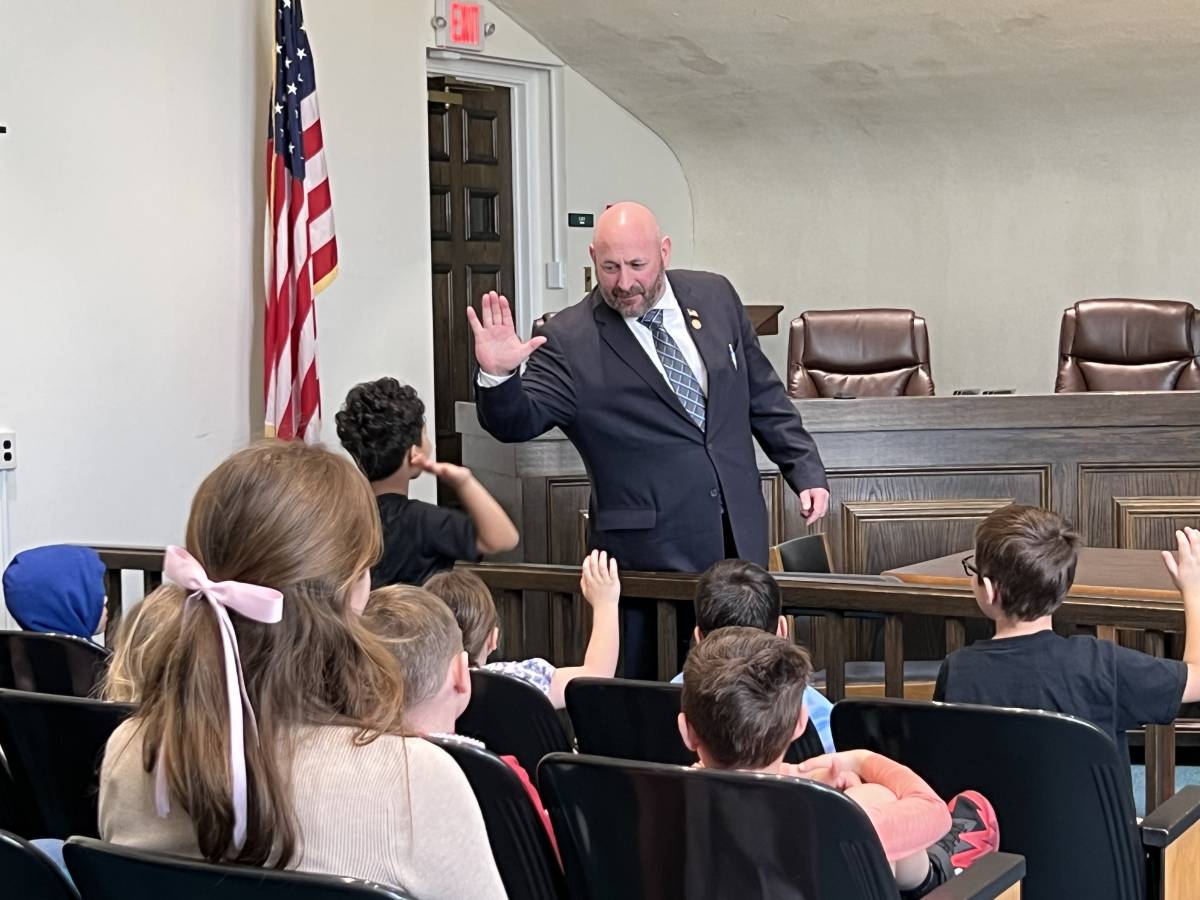
Inside the Council Chambers, First Selectman Terry Rooney, Police Chief Keith White and Fire Marshal William “Bill” Davin took turns talking to the class.
Rooney entered the Chamber and exchanged high fives with some of the students seated in the front row.
“This is government,” he said, looking around the room. “We don’t always have the best environment, but we do a lot of good work here. Does anyone know what I do?”
A girl said the first selectman tells the police chief what to do.
“I love it, but the police chief wouldn’t like that,” Rooney said.
“You run the town?” another girl asked.
“Yes,” Rooney said. “We keep things safe, nice and try to fund everything and keep taxes down. You like the parks? We make sure the parks are nice and clean. DPW … people complain that the roads are a mess and they make them nice.”
The first selectman said he and the Town Council create bills and laws for Monroe. “We actually passed a law for senior tax relief,” Rooney said. “I came up with an idea and put it before attorneys, and brought it to the Town Council to see if they agreed with me or not. I can’t do anything without the support of the people here,” he added, while looking at the empty Town Council seats at the dais behind him. “There are nine members.”
“Who is ‘we'” a boy asked.
“Collectively … I don’t do anything myself, it takes a team,” Rooney said. “Do you play soccer? There’s no ‘I’ it takes a team.”
“What kind of jobs do you do?” a girl asked.
The first selectman mentioned the Rails to Trails project on the beach side of Wolfe Park and several road projects like Old Zoar and a recent sprucing up of the historic Stepney Green. Rooney also said it is possible there could be a new school, depending on the findings of the new building committee.
A boy asked how many police officers there are. Rooney said there were 42, but minor incidents and complaints over speeding influenced his decision to add two more, bringing the police force to 44.
One student asked who the boss of America is. Rooney said Washington, D.C., and another boy asked why we always have to care for our country and other countries when people need help.
“I think it’s important to care about people,” Rooney said. “If you see a neighbor fall off a bike, would you help them? It’s the same thing.”
Police work around the clock
The police chief spoke next.
“Today, we’re going to talk about emergencies,” White said. “What’s the most important number?”
“9-1-1” the students replied in unison.
“When do you call?” White asked.
Students quickly called out: “fire” and “crime.”
“What’s the third type of call?” White asked.
“If someone get’s hurt,” one student said.
“Fire, police and medical,” White confirmed.
He said a dispatcher handles every call and asks, “what is your emergency?” If the caller says everything is okay, White said an officer will still come by to check on them and make sure. A computer screen pinpoints the location of every call on a map.
“If you call 9-1-1 and hang up, we’re going to come with lights and sirens,” White said.
The chief said the police department is always open and its officers are the first to respond to all three types of emergencies. If it’s 10:30 on Christmas night and someone slips and hurts their leg, White said police officers come with medical equipment before the ambulance arrives.
How do the police protect the town around the clock?
The first shift of officers arrives for work at 8 a.m. and finishes at 4 p.m., the second shift is on duty from 4 p.m. until midnight and the third shift works from midnight until 8 a.m., according to White. “It goes like that every day,” he said.
‘Beep, beep, beep’
When the fire marshal spoke, the first thing he did was show the children the illuminated red exit lights over the doors of the Council Chambers. Even when lights are lost in a power outage, Davin said these signs, which are battery powered, are lit to show people the way to safety.
“I make sure fire safety rules are enforced,” Davin said of ensuring these exit signs have fresh batteries and that smoke detectors, sprinkler systems and other measures are in place in the event of an emergency.
“We check here, at businesses and schools to make sure lights work correctly,” Davin said.
He held up a smoke detector. “You have this on the ceiling in your house,” Davin said. “The smoke detector smells for smoke.”
When the detector smells smoke, Davin said it goes “beep, beep, beep” to alert people in the house.
Davin noted how students and teachers go to a safe place outside during a fire drill at school. “Do you have a safe spot at home?” he asked. “If not, tell your parents, ‘the fire marshal said we need a safe place outside to meet.'”
If the detector goes off, you feel a door and it’s hot, Davin asked what you do.
“Don’t open it!” a boy called out.
After his talk, Davin said, “thanks everybody for being good listeners and enjoy your day.”
Growing up fast
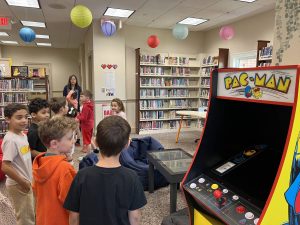
Teachers led their classes outside and up the sidewalk to Edith Wheeler Memorial Library, where the first stop on their tour was the Children’s Library.
“Raise your hand if you’ve been to the library before,” said Wendy Fox, an assistant children’s librarian.
All of the children raised their hands.
“What we’re doing to show you here is what you can do at the library,” Fox said. “Library cards are the most important thing.”
She asked the children what they thought the card costs and after hearing a few dollar amounts, Fox said, “it’s actually free. Everything at the library doesn’t cost you money. You can check out a book and bring it back.”
However, Fox showed the students one exception. She held up a book that had been damaged by a young reader’s spilled juice.
“Sometimes there are little mishaps,” Fox said. “That’s the only time you need to pay for something. We don’t get angry about it. We just take care of it.”
Other topics Fox talked about were the differences between fiction and nonfiction and about comics, which are called graphic novels. Aside from books, she said library patrons can use their cards to check out puzzles, toys like American Girl dolls and DVDs.
“Ms. Nicole will show you what to do to check something out,” Fox said.
Nicole Wiedenmann, a library aide who works behind the front desk, took a card from Fox and scanned it. Then she opened the back of a book and scanned the code. Now the book and library card were linked, allowing librarians to know who had the book and when it should be returned.
Fox took the students on a tour around the children’s area, which had shelves of books and play spaces, before the group went upstairs to see the adult and teen areas.
Upstairs, Fox showed the group the Library of Things, which has a wide variety of items to check out, from metal detectors, a coffee maker, a juicer and a lacrosse helmet to a grilling skillet.
A man was working inside a Nook, an individual workspace resembling a little house. Fox said the library also has PODs.
The adult area also has periodicals, books, a computer area and puzzles.
“This is the MakerSpace,” Fox said of an enclosed room full of 3D printers and other equipment used to create things. “You can make an appointment and learn how to use it.”
Next was the cafe and the teen area for library patrons who are age 12 and older. This was popular with the children. It had beanbag chairs, a classic Pacman arcade game and other fun electronics.
“Isn’t this awesome?” Fox asked. “You want to be a teenager? You will be one before you know it. Blink your eyes and you’ll be a teenager.”
All respectful comments with the commenter’s first and last name are welcome.