

MONROE, Conn. — Beginning with the preamble, “We the people … ,” the Constitution of the United States is the law of the land, outlining the freedoms Americans enjoy, governmental powers and a system of checks and balances to ensure a government without kings, which the country’s earliest settlers had fled to the New World to escape from.
While it is arguably the country’s most important document, most are only familiar with certain parts of it. On Thursday night, State Sen. Sujata Gadkar-Wilcox, D-Trumbull, a Constitutional scholar who teaches at Quinnipiac University, made a presentation on this historic document to 27 people gathered inside the Ehlers Meeting Room of Edith Wheeler Memorial Library.
“I just want to give you some highlights of this document and talk about things coming up in our contemporary time,” she said. “People are concerned over the Constitution now. To me, it’s not a partisan issue.”
There are questions over whether the U.S. is a pure democracy. Gadkar-Wilcox said the U.S. is a constitutional republic and representative democracy.
“We’re not a direct democracy,” she said. “We’re a republic with institutions like Congress and the courts with a system of checks and balances.”
In the Federalist Papers, James Madison wrote about the separation of powers in Articles 1, 2 and 3, according to Gadkar-Wilcox, adding the U.S. has the executive and legislative branches and the judiciary.
She said these powers have came into conflict when the president refused to authorize funds approved by Congress. Gadkar-Wilcox said the Take Care Clause in Article II, Section 3 of the U.S. Constitution, mandates the president “shall take care that the laws be faithfully executed.”
“As an executive, you cannot target states with any administration,” she said. “As a Democrat, I can’t say, ‘I’m not funding red states,’ or as a Republican, you can’t say, ‘I’m not funding blue states.'”
Among the powers of the federal government outlined in the Constitution are war powers, coining of money and the delivery of mail to name a few, which are balanced out by the broader reserve powers of the states.
“There is no absolute fundamental right in the Constitution,” Gadkar-Wilcox said. “Even when it comes to the right of free speech, there are limits of defamation and obscenity. That bar is very high, but there are limits.”
She said the Constitution is meant to create principles that should be lasting with no titles of nobility. “You serve the office and when you leave, you’re an ordinary person,” she said.
Conflicts over jurisdiction
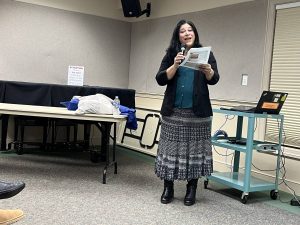 Gadkar-Wilcox said Republicans used to favor states’ rights over centralized federal power. But now that the federal executive is a Republican those narratives have switched. She said parties may change their position based on their own political interests, which makes it even more important for the public to come to its own independent judgement on how we should balance power between the federal and state governments — no matter which party is in charge.
The senator said states have their own constitutions, which can expand upon the freedoms within the federal constitution, but cannot limit them.
Oftentimes, the jurisdiction of the states and the federal government come into conflict. For example, immigration is under federal jurisdiction, but states have their own protocols for enforcement. Gadkar-Wilcox said a court officer may ask an Immigration and Customs Enforcement (ICE) agent to identify himself, before coming into court armed.
She said the Refugee Act of 1979 and the Refugee Act of 1980, codifies the principle of non-refoulement, which means an individual cannot be returned to a country where they will likely face persecution. They have the right to a hearing to determine whether they have a credible fear of persecution.
“There has to be due process,” Gadkar-Wilcox said. “We have to sent people back to countries where they claimed to have faced torture.”
The senator also talked about the Writ of Habeas Corpus, the right to due process which protects against unlawful confinement, acting as a safeguard for personal liberty against arbitrary government power. Gadkar-Wilcox said this was established, because British troops questioned and pulled citizens off the streets leading up to the American Revolution.
‘The will of the people’
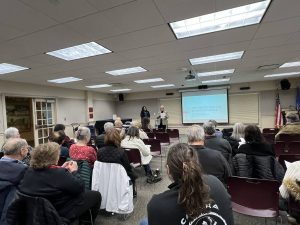 One man attending the presentation expressed concern over a lack of teeth in the Constitution, because President Donald Trump called a Georgia election official asking him to find more votes after losing the 2020 Presidential Election, but avoided any punishment for the alleged interference.
“I’m not blind on these things, but I’m hopeful,” Gadkar-Wilcox said. “These actions were stopped by the courts.”
Whenever there are conflicts, she said Americans have the Constitution to point to to identify violations.
“That’s what’s bringing people out,” she said of the Minnesota protests against ICE. “There was not a lot of talk about reforming ICE, until there were problems and people started looking at the Constitution and the Federalist Papers. We’ve seen power curtailed and the court is even influenced by the will of the people.”
Aside from voting, calling their representatives and protesting, Gadkar-Wilcox said people can write Op-Eds on topics to get involved with their government.
“Guess what? The courts read the Op-Eds,” she said. “I wrote against gerrymandering districts. Both parties have been guilty of gerrymandering. I think the courts should come in and un-gerrymander all the districts.”
Gerrymandering is when voting districts are redrawn in such a way as to include voters more likely to support candidates from a specific political party.
Public comments touched on war powers and the Iran conflict. Gadkar-Wilcox said tensions between presidents entering wars without a vote in Congress is nothing new, but “the reason we didn’t hear this before was past executives were at least in dialogue with Congress. These are clear violations of the spirit of the Constitution and the War Powers Resolution.”
A woman with the League of Women Voters expressed concerns over the Safeguard American Voter Eligibility Act or the SAVE Act, which would require certain forms of identification for proof of citizenship before being allowed to vote and lead to penalties for violators.
Gadkar-Wilcox said there has been pushback over a requirement that a woman’s last name be the same on her I.D. to vote, because it would make it more difficult for married women who changed their names to vote.
She also discussed jurisdictional conflicts over the federal government’s demand for voter data from states.
“The states are responsible for overseeing elections and voting,” Gadkar-Wilcox said. “Now the federal government is creating rules for I.D. and demanding the sharing of voter data, causing problems.”
She compared it to a hypothetical scenario of Connecticut being required to turn over its voter data to the state of New Jersey, when New Jersey has no jurisdiction over its elections.
One man pushed back on that, asking if there would be any danger in federal elections being centralized, so the rules are uniform for all states.
Gadkar-Wilcox said there is a relationship between the federal and state governments for elections. The states determine the time, place and manner of elections and the federal government has oversight ensuring those processes are fair.
“The framers were extremely wary of concentrating more power centrally,” she said. “I’m happy we have a decentralized process. Then you can’t just say, ‘we’re not having any elections.’ The framers trusted the states more than the federal government.”
All respectful comments with the commenter’s first and last name are welcome.
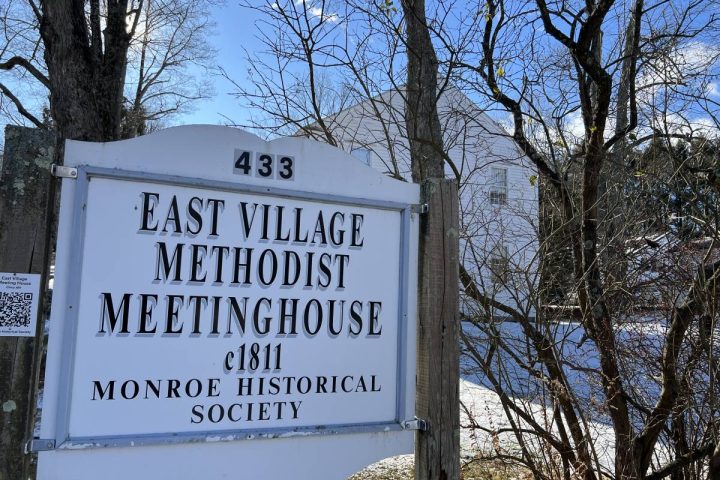


I believe that it is vital to our continued way of life to examine and reflect on the fundamental and foundational basis for our government, laws, and actions taken.
Thank you very much to State Sen. Sujata Gadkar-Wilcox and the Monroe Sun.
I wish that all of our elected politicians would take time to engage in a similar public discourse and ethics lesson.