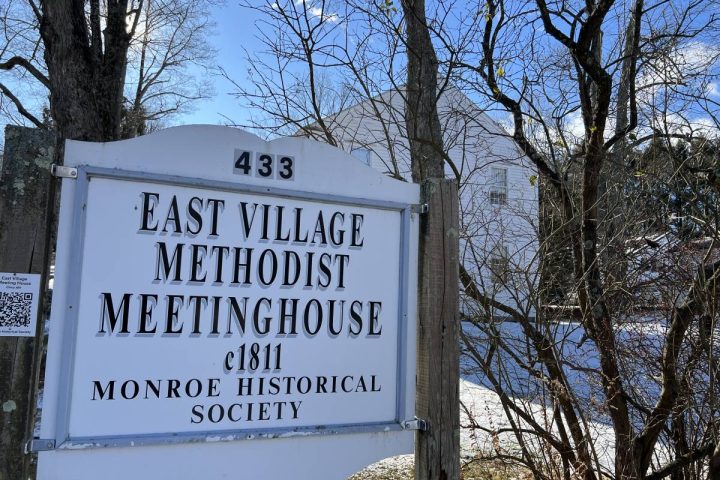
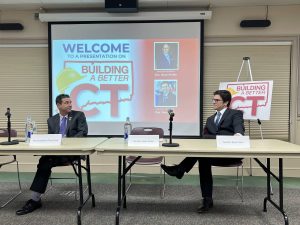
MONROE, CT — A panel of Republican state legislators recently hosted a forum entitled “Building a Better Connecticut” in the Ehlers Meeting Room of Edith Wheeler Memorial Library.
Sen. Ryan Fazio, R-Greenwich, who is challenging incumbent Democrat, Ned Lamont, in the upcoming governor’s race, headlined the event, which also included Rep. Tony Scott, R-Monroe, and Sen. Jason Perillo, R-Shelton.
First Selectman Terry Rooney, who attended the forum on Dec. 3, said residents can expect similar events throughout the year. “We are going to be doing more of this,” he said, adding the discussions will look at things local leaders can do to help different areas of the community.
Fazio focused on affordability, in light of Connecticut’s “sky high” taxes and utility costs. He said electric bills include costs for supply, transmission, distribution and a Public Benefits Charge.
“The first three make sense,” he said. “Public Benefits is about 20 percent of our electricity bills. It represents over 55 different government programs financed by your electric bills.”
Fazio said the Public Benefits Charge amounts to over $1 billion per year statewide. “This is something actively driving our rates higher than other states,” he said.
He discussed Republicans six-point energy plan, which calls for the elimination of the Public Benefits Charge in phases to reduce electric bills by 15 to 20 percent.
Fazio also proposed a $1,000 middle class tax cut, while state legislators reduce the rate of growth in annual spending. “We have to tighten our belts in Hartford and reduce special interest credits to fund a tax cut,” he said.
The gubernatorial candidate called for a property tax limit in Connecticut and for the reduction of unfunded state mandates, which place a financial burden on towns.
Affordable Housing
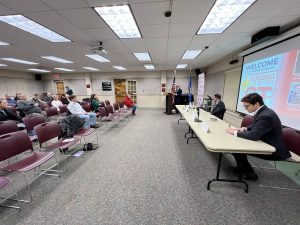
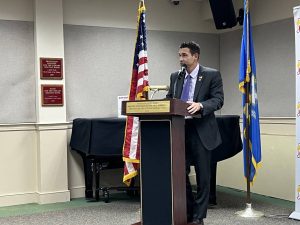
Scott, who is ranking member of the Housing Committee, told voters about Housing Bill 5002, which had passed both the House and Senate, before the governor vetoed it in June.
The legislation, which allows residential housing on commercial properties as of right, was revised and re-introduced as H.B. 8002. It was passed by both houses and signed into law by Lamont.
Scott disagreed with the process, saying it was passed in Special Session, “which should only be for emergencies.” Scott said this allowed for the circumvention of some things required in the usual process.
Legislators had a “sneak peak” of a 99 page draft of the bill on the Friday before the vote on a final 104-page version. State representatives only had 40 minutes to review it before making a decision, according to Scott.
“The process is broken,” Scott said. “It’s legal, but not the way it should be run. I thought we could have massaged the bill to make it more workable.”
Scott said Democrats have a supermajority in both houses, enabling party leaders to push things through. While he said he would love to have more Republicans elected, Scott pointed out that some Democrats also voted against the housing bill, so the most important thing is electing like-minded people, he added.
His main concern was the loss of control for Monroe’s locally elected land use boards. He said towns’ decision making is being stripped away.
Scott said the new housing law will require Monroe to create a Fair Rent Commission and a housing growth plan to pursue the number of housing units that Connecticut deems to be Monroe’s “fair share” of the state’s overall affordable housing goal.
The report must be done every five years with annual updates or the town could lose state funding.
Scott said one of the most difficult aspects of increasing affordable housing in Monroe is the fact that the state has a different definition of what counts as affordable. For example, though The Hills of Monroe is all affordable, it doesn’t meet the threshold, according to Scott.
He said that also goes for mobile homes.
Monroe is limited in its capacity to build dense affordable housing communities, because it does not have sewers, according to Scott, but he said this could change.
“Supposedly, the state put aside money for sewers,” he said.
Scott said there are some good things with the new bill, but that it puts too much power in the hands of activists, rather than looking at the total picture of the state. Scott said he believes Realtors, builders and banks should come together to work on a better solution.
“Housing is a hot topic and it’s not going away,” Scott said. “The place you’re living in now won’t be the place you moved into.”
Perillo said he believes pushing density on the suburbs takes away from the cities, which need affordable housing most. “They need people living and working there and the businesses will follow,” he said.
Restoring trust
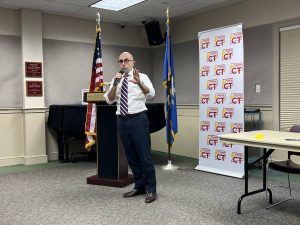
Perillo spoke of ways to restore the public’s trust in government.
“One of the biggest reasons I hear for not voting is, ‘it doesn’t matter. You’ll do what you want to do anyway,'” he said.
The senator recalled how someone was caught on camera stuffing a ballot box five years ago, leading to the first time someone was charged with a federal elections violation.
“It happened to be Democrats doing it. I’m not trying to be political,” Perillo said.
To help ensure election integrity, Perillo proposed requiring identification for absentee ballots, just as an ID is presented at the polls.
He also proposed oversight of the state treasurer’s fiduciary control.
Perillo also spoke of the need for reforms for law enforcement, to encourage an increase in qualified candidates. He noted how municipalities often have to hire away a police officer from another town’s department to fill a position, due to a lack of new candidates.
“Nobody wants to do the job any more,” Perillo said. “There are less applicants. Police officers realize they could get sued while enforcing the law. The state of Connecticut overreached on police accountability, so we can’t find good police officers. You don’t necessarily have to roll it back all the way, but we need to make it so the most talented people can become officers.”
All respectful comments with the commenter’s first and last name are welcome.