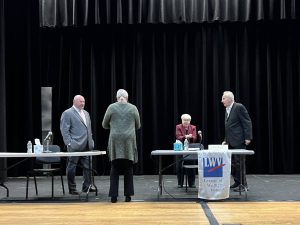
MONROE, CT — Jean Rabinow of the League of Women Voters moderated a debate between first selectman candidates Terry Rooney, the incumbent Republican, and Leon Ambrosey, the Democratic Party challenger, in the Jockey Hollow Middle School auditorium Tuesday night.
The candidates answered questions submitted by residents on a wide range of issues, from the budget and taxes to school infrastructure needs and local zoning.
This article includes some highlights, but the entire debate can be seen on this YouTube video made by Brian Fitz:
Each candidate had up to two minutes to answer a question. Then each candidate had 30 seconds to either extend or rebut a remark. At the end of the debate, each candidate had three minutes for a closing statement.
What do you think is the most serious issue facing Monroe and, if elected, how would you deal with it?
Rooney said state mandates are the most serious issue facing the town, impacting costs on education and law enforcement, while creating an unnecessary burden on everyone, especially seniors.
Ambrosey agreed on mandates, but said the town’s roads and infrastructure is falling apart and overcrowded schools are the most serious issue.
“We have paved more town roads this year than ever before,” Rooney said in his rebuttal. “We started an actual paving operation within our town to pave our roads. Everybody has seen that difference.”
On the issue of schools, by state law, Rooney said the Board of Education does not fall under the first selectman’s purview, rather it is under the superintendent. Rooney said the first selectman cannot control line items in the school board’s budget.
“You cut the budget for the Board of Ed,” Ambrosey said, adding board members put forward their budget with a bipartisan, 9-0 vote.
“In regards to the budget, there wasn’t a budget cut, there was a reduction of an increase,” Rooney said. “… in fact there was a significant increase in the budget.”
During the process for the 2025-26 budget, the school board had requested a $4,303,370 or 6.02 percent increase, before Rooney reduced it by $1,850,000.
He said it was to offset the state-mandated revaluation, in which property values “skyrocketed” impacting residents’ property taxes.
Rooney said the town lowered the mill rate from 38.27 to 28.67 to lower the financial impact on seniors and those living on fixed incomes.
St. Jude School
Ambrosey wondered if work on the wall outside the gym at the former St. Jude School was built into cost of the town’s $3 million purchase that taxpayers approved or if the project will end up costing more. He also asked when the building will be done.
Rooney said $1.2 million of the money was for repairs, adding the estimate to repair the outer wall by the gym was $1 million and he believes the town got it done for around $482,000.
Rooney said the town will get the community center up and running. “We’re using LoCIP money, we applied for Brownsfields grants, which we achieved,” Rooney said. “I hired a grant writer. We have received a lot of money. We’re trying to do it with very little impact on the taxpayers.”
He said the town is doing the project little by little, “because we don’t want to put pressure on our citizens.”
One of the submitted questions asked what the plans for the new community center are.
Rooney said a study was done when the town pursued the purchase of the former St. Jude School for a community center under his predecessor, Ken Kellogg’s administration.
Rooney said he recently opened the IT Department offices there as an upgrade from its old space behind Monroe Elementary School. An outside wall was repaired and work is now being done on the gym.
Once all health and safety issues are resolved, he said the goal is to move the Parks and Recreation Department there with its programming.
“We are getting very, very close to doing that,” Rooney said, “and I’m hoping that when we open we can have indoor pickleball.”
Monroe just underwent a revaluation, what, if anything, could have been done to ease the burden on the taxpayer?
Rooney said he made a reduction in the increase to the Board of Education budget and reduced the municipal asks to ease the burden on seniors and those on fixed incomes.
“We took $4 million from the undesignated fund balance to mitigate the damage of that reval,” he said. “That is a state-mandated reval. There’s nothing any administration across the state could do. It doesn’t matter what town, they’re all dealing with it. We did the best we could to reduce the impact of this tax increase and I’m really proud of what we did.”
The mill rate was lowered to 28.67, but Rooney said he really wanted to get it down to 25. He vowed to fight to get it there to “correct the impact of that reval.”
Ambrosey asked Rooney if he looked into phasing the reval in over a few years to reduce the impact on taxpayers, which Connecticut allows towns to do under a state statute.
“Did you bring it to the Board of Finance?” Ambrosey asked. “And did you bring it to the Town Council or even to our tax assessor to see? Because some of these families really got hurt by this reval. And even the seniors got hurt.”
Connecticut allows towns to phase in a property revaluation over up to five years to spread out the impact of increased assessments incrementally, making the tax increase more gradual.
Rooney said he did not push the revaluation off during election season, instead taking it on now and reducing the impact as much as possible. He said phasing would result in increases from the revaluation hitting taxpayers every year.
Ambrose said phasing it in would allow people to prepare for the increases.
The school budget is always a contentious process. Would you support voting on this separately?
Rooney said the town will have to consider charter revision at some point for a lot of reasons. “I see benefits to it. I see things that are challenging about it,” he said.
“We want to educate our kids. We want to take care of our kids, but the cost is concerning,” Rooney said. “There may be a way to let the community speak. We have to take care of the people in town who have kids in the schools and we have to take care of the people in town that do not, and that would probably give everybody a voice.”
“I don’t support it,” Ambrosey said. “I think the budget should be one budget. You have a municipal side and you have a school side.”
Ambrosey said volunteers serving on the Board of Education give a lot of their time to the budget process, usually resulting in cost-effective recommendations. “I believe the same thing on the municipal side,” he said.
“I believe it should be one decision, because if start defeating school budgets, you have to cut the schools and teachers are let go and the schools are already overcrowded, so what are you gonna do?” Ambrosey said.
Rooney accused Ambrosey of “double-talk,” promoting things that would raise taxes, while simultaneously talking about lowering taxes.
“It’s not about raising taxes,” Ambrosey said. “It’s about taking care of the needs of the schools.”
One budgeting question asked how each candidate would avoid cutting the arts in the future.
Rooney said the town has the Arts in the Park program and he is not canceling that.
Both candidates agreed the superintendent and Board of Education decides on funding the arts. But Ambrosey pointed out how, when education funding requests are reduced, the arts are usually the first thing that is cut.
Why are my taxes going up and what can you do to stop it?
“Everything is going up,” Rooney said. “When things go up in your houses, they go up in the schools. Electrical costs are through the roof and you can only imagine what it costs to run a school.”
He said medical insurance is also going up.
“I’ve done everything in my power to mitigate both of them, negotiating good electric deals and negotiating good health care,” Rooney said. “But these things continue to go up.”
He said the town’s directors, the Board of Education and Superintendent Joseph Kobza need to take a close look at operations.
“On the municipal side it was a very, very small increase,” Rooney said. “We need to look at everything to prevent taxes from going up, but it’s very difficult to do with state mandates, electric costs and medical costs.”
Ambrose agreed that state mandates are a problem, but said, “I believe that we created our own problems by not maintaining our stuff in town. Our road conditions have gotten worse. Our buildings are getting worse and this is going to address taxes for people in Monroe. We can’t just stand by and let this go on anymore. This has to be taken care of.”
Ambrosey said whoever wins the election will have to see if there are ways to cut taxes.
What is your position on tax relief for seniors?
Ambrosey said he is a senior citizen himself and that he recently spoke to Monroe Senior Center patrons about their concerns. He said the town has to try to keep its seniors in town.
“If they sell their houses, it’s going to create more students in town,” Ambrosey said of the increased education costs, “so I’d rather keep the seniors in town.”
After he was first elected, Rooney said he worked to raise the tax ceiling so more seniors would be eligible for the town’s tax relief program. He said he raised it from $60,000 to $75,000.
Rooney said he worked with the Commission for the Aging and its chair, Susan Bannay, in a bipartisan manner to do that.
“We wanted to see what the impact was,” Rooney said, “because of the reval, we didn’t want to make too many drastic decisions. But my goal in the next term is to bring that up to 85, because the tax impact was not as extreme as we expected.”
“I agree with Mr. Rooney that we need to do that for the seniors,” Ambrose said.
If elected, what are you going to do for veterans?
Ambrosey said he is not up-to-date on what towns could do for veterans adding, “but I would try my hardest to take care of veterans. Veterans who served our country need as much help from the state and from the local towns to help them get through whatever it is they need.”
Rooney said he agreed with the state when it enacted complete tax exemptions for fully disabled veterans in the last tax year.
“We administered that in the town of Monroe at the last budget,” he said, “so any veteran in Monroe who is fully disabled got a complete tax credit on their house tax.”
In addition to that, Rooney said a project to build a Veterans and First Responders Center in Trumbull ran out of money and he is in talks about Monroe assisting Trumbull with the assurance it will lead to the center being built.
Do you support the reopening of Chalk Hill School or should something be done with it, such as converting it to housing?
Ambrosey said he supports looking into reopening Chalk Hill as a school. “I talked to Joe Kobza and he told me the schools are overcrowded,” Ambrosey said. “We need to have more room.”
He said the superintendent told him adding a third floor to Chalk Hill would allow the district to house some things there, rather than at Masuk High School, freeing up space there.
Rooney said he also spoke with the superintendent and that he visited the schools to see the conditions.
“Between myself and my opponent, I’m the only one who built a municipal building,” he said. “I built the EMS building and I built the animal control building. When you rehab a building there are inherent problems.”
“We need to build a new school, if at all,” Rooney continued. “If we do need it, we need to build a new school. But the state or the federal government needs to cough it up. We all pay a lot of state income tax. Bridgeport got three $129 million schools. It’s about time the state pays for a school for our town.”
What are the real needs of school facilities and how will these needs affect the taxpayers?
Rooney said the town approves a capital plan, which includes school projects and it recently approved a new roof for Fawn Hollow Elementary School, but it was pushed back by the Board of Education because of the facilities study.
He said there is a freeze right now because of the study, which is understandable. Rooney said the town has old buildings it tries to preserve, adding the question is really more for the superintendent than the first selectman.
Ambrosey said Monroe’s school buildings are old and falling apart, and need to be updated.
“This is not something that just came in overnight,” Ambrosey said. “This is something that has needed to be done for a long time. The town needs to take the approach to start fixing these buildings.”
He said not doing so could pose safety hazards for kids at the schools.
Rooney said repairing schools has always been under the purview of the Board of Education.
“We have to allow the money for that to happen,” Ambrosey said.
Road maintenance
Ambrosey said the town’s roads are being surface coated now to give it a few more years, but there is still a problem with drainage. “The roads are deteriorating underneath,” he said, adding it is not fixing the root problem.
“My opponent is really out of touch,” Rooney said. “We are doing the drainage to do what needs to be taken care of with the infrastructure … There are three options: reconstructed and paved or surface coated or surface paved.”
What, if anything, can you do to improve road maintenance and or in-line traffic flow?
Ambrose said the town’s DPW is doing the best it can with road maintenance. “I believe they’re doing a good job,” he said.
But Ambrosey said the town could hire a company with the technology to see road conditions, which ones need to be fixed first, as well as the ones that need major work.
“That could be put on a website, so all residents can see how their road is and what needs to be done,” Ambrosey said.
“We have a PCI, we’ve done studies, we know what our roads’ conditions are,” Rooney said. “We purchased a roller and paver to do our own roads. We’ve never done that in the history of Monroe. We’re doing that now. This year, we have done significantly more roads. We have saved a lot of tax dollars doing it.”
“Not only is the scheduling easier, it’s cost effective,” Rooney said. “We buy asphalt directly. We don’t have to use a middleman. If there is a delay because of rain, we can get back to working. We don’t have to wait for a company.”
He said the town works hard on road maintenance, increasing the bonding every year for multiple years.
“The taxpayers would like to know when their roads are going to be fixed,” Ambrosey said, “and they said that they go up to Town Hall sometimes and they don’t know when that road’s going to be fixed.”
“I think if Mr. Rooney is right, and he knows what roads need to be fixed and the condition, maybe we should put something on a website on what roads are going to be fixed and what roads are not going to be fixed, so at least the taxpayers know when the roads are going to be fixed,” Ambrosey said.
After the slow response to the summer floods a couple years ago, if you are elected, what are your plans for a future response for events caused by climate change?
Ambrosey said no one is to blame for the hundred year flood and that the first selectman could answer better if the DPW has a plan in place for future events.
Rooney said, “I will be honest with you. I don’t know who asked that question, but I personally take offense to it and I can assure you that our Highway Department and DPW does as well. We worked around the clock for eight days trying to get those roads together before school.”
Rooney said the town not only succeeded in doing that, but it was the first town to receive FEMA money.
He also said it was a thousand year flood, a disaster situation. Rooney said he is proud of the DPW for working hard and efficiently in getting the job done, adding its union endorsed him for first selectman.
What should Monroe do to increase commercial development?
On the Planning and Zoning Commission, Ambrosey said they have subcommittees that work with developers, and if there is something members believe is good for the town, they look at regulation changes that could make it happen.
“In the last two years under my leadership, we have brought in 84 new businesses,” Rooney said. “We are doing that job.”
“How many businesses have been lost?” Ambrosey asked. “And what kind of businesses are you talking about?”
Ambrosey questioned where Rooney’s claim of 84 new businesses came from.
Rooney said the number comes from Monroe Economic and Community Development Director William Holsworth.
“There are a multitude of businesses,” Rooney said, “and I can assure you, since I’ve been here it has not been pizza places, nail salons or liquor stores.”
We have zoning laws in town. Why are they not being enforced?
Rooney said zoning laws are being enforced and used business signs as an example. Ambrosey said a few businesses had flashing signs, which is why the Planning and Zoning Commission he serves on regulated it.
What steps will you take to curtail developers from starting construction and leaving a mess? See Route 25.
“It is a mess and I am working diligently with people to try to get projects there,” Rooney said.
However, he said a first selectman does not have purview over what goes through planning and zoning or what is deemed illegal on a site. Rooney said he puts his trust in his Planning a Zoning administrator and in the commission to determine through regulations what is best for the town.
Ambrosey said the Planning and Zoning Commission has talked about some kind of incentive to make Route 25 grow. He suggested something like a village district, where properties are connected and people could go shopping and have ice cream.
Ambrosey said the town could offer a tax break. “But we have to do something, because Route 25 is a disaster,” he said.
Ambrosey said some things were approved for Route 25, but not built yet, and Rooney said there has been more interest from developers.
Should Monroe do anything to prevent apartment complex construction and if so, what?
“We looked at it on Planning and Zoning,” Ambrosey said. He said it hard to attract retail, so developers asked if they could have apartments over the businesses.
“I’m for that. But I’m only for one bedrooms,” Ambrosey said. “I don’t think that we want to do two bedrooms or anything like that and that would offset their costs.”
Ambrosey said allowing two or three bedrooms would bring in more children at a cost of $21,000 per student.
Rooney said the Planning and Zoning Commission has taken correct action in slowly introducing mixed-use developments. “It’s a good start, but the town has to be careful not to let it get out of control,” he said.
Rooney said House Bill 5002 would have allowed multi-residential housing to be built on empty lots in Monroe’s commercial sectors.
“Currently, Monroe has control over those decisions,” he said. “The state is pushing us to develop more housing. I wrote a letter to the governor to veto HB 5002, because of the impact it would have on Monroe. I think Monroe is doing it right in a sense that we’re doing it slowly to see how it impacts our community.”
Governor Ned Lamont vetoed the bill after hearing many concerns from state and local government leaders.
How do cluster residential developments affect our taxes? And what are your plans, if any, to control cluster development?
“Cluster developments are a nice way to preserve nature,” Rooney said. “When you have a plot of land, you have a legal right to build on that property.”
He said cluster housing allows developers to build the same amount of houses it could in a conventional subdivision, but closer together on smaller lots to preserve more land as open space.
Rooney mentioned Aspetuck Land Trust and the recent acquisition of a Benedict family property as open space. “I believe in preserving as much open space as possible,” he said.
While it is true that cluster developments preserve more open space, Ambrosey said some developers opt to do it because they have properties with a lot of wetlands that they could not build on otherwise.
“Sometimes cluster development is good and sometimes cluster development is bad,” he said. “It all depends on what the property is.”
When some developers want to build cluster housing on land that is half wetlands, Ambrosey said it could allow them to build more homes, leading to more students and higher taxes.
Closing statements
The following are the candidates’ closing statements.
Rooney: I was elected as your first selectman. I promised to collaborate, to work closely with people and to care about your needs. I have done that. I have not only been proactive, I have been reactive.
I have been reactive on social media. I have responded to your calls, whether it’s a pothole, whether it’s a lawn being mowed at the corner of Elm Street and 111, I have been there and listened to this community’s needs.
When people have complained to me about speeding, I responded. I have done UConn studies and put up speed signs to slow that down and the accidents are down about 20 percent last year alone.
When you talked to me about the roads, I put together the paver and the roller to do a better job. Everything that this community has asked me to do, I have done. I have been transparent. I have worked across the aisle. I have done ordinances such as the Senior Ordinance in a bipartisan manner.
I have looked at Monroe holistically and I have cared about it holistically. I have met with hundreds of people in my office — people who weren’t happy and people who were, and I have tolerated and listened to every single critic that has been out there and I have responded with grace and decency and integrity that this position deserves.
I will continue if you reelect me as your first selectman to listen to you, to be transparent as I have proven I can be and have been, and I will do what this community needs. When this community needs something, I respond, I react, I have proven to do so.
Ambrosey: I’m a business owner. I have done all my business in this town for 30 years. I have an auto repair business and I solve problems for my customers … I give them an honest day’s work and tell them what I’m going to do to repair their car. I have a good rapport with a lot of people in town and I have a good customer base of people who support me and recommend me.
My family lived here for 27 years and my kids all went to school in town and I’m here because I think that the infrastructure in our town is falling apart. I mean, the roads is one thing, but the schools are falling apart and we need more room for our schools and I wasn’t sure that Mr. Rooney was going to allow it to happen as far as taking care of the school needs.
So that’s why I got involved, I only got involved for one reason … because of the schools. I talked to people who had concerns for people in the schools and for the safety of the kids in schools.
He finally released Chalk Hill back to the Board of Education, so we can fix Chalk Hill and take care of that problem.
I thank you all for coming out. I’m a business owner. I’m here to try to get things done. I’m not going to say I know everything about it, but I will find out about it, because that’s the way I am.
All respectful comments with the commenter’s first and last name are welcome.