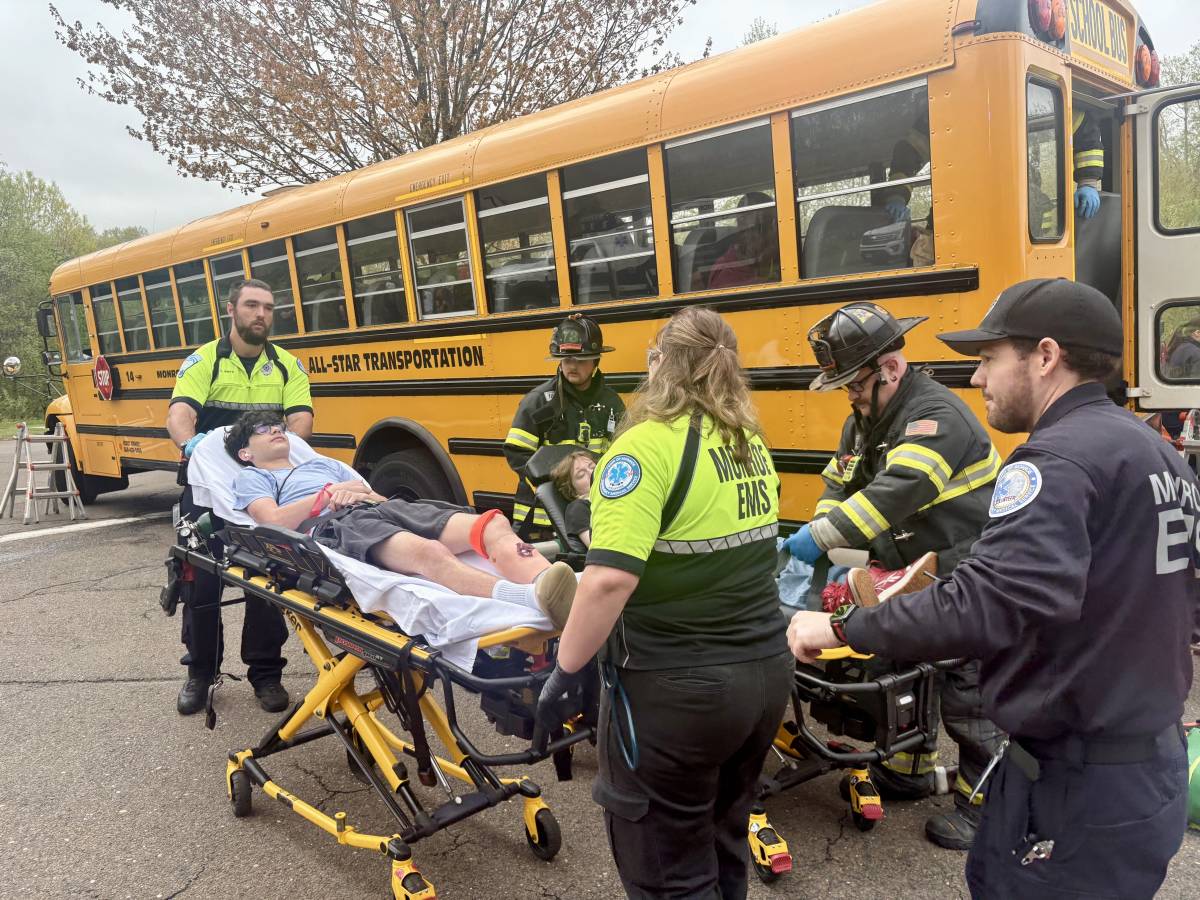
MONROE, CT — Stepney Fire Chief Darren Dyson was the first emergency responder to arrive at the accident scene near Chalk Hill School one recent Sunday morning. In a mass casualty drill, the nightmare scenario was a three-vehicle-crash involving a school bus carrying 21 students and a special education para-professional.
The bus driver suffered a medical episode, causing the bus to veer off the road, while triggering a second serious crash involving a BMW and a minivan with seven combined occupants. The BMW jumped a guardrail and was in danger of sliding down an embankment.
Dyson, who served as incident commander for the drill, had mere seconds to assess the situation and notify the resource center about what was needed. Among his first tasks was providing order amid a chaotic scene.
“You can’t have ambulances, fire trucks and police cars all arrive and park anywhere,” Dyson said. “It has to be organized and you have to have a plan in your head within a minute and execute it.”
Dyson had fire apparatus park on the right side of the road and ambulances to the left. All medic and chiefs’ vehicles parked on the grass. This ensured a clear path for ambulances to get in and out, while taking patients to hospitals.
Fifteen Monroe Community Response Team (CERT) volunteers acted as concerned parents.
 Dyson had Monroe Police Sgt. Todd Keeping and Det. Stacy Cascante set up an area for parents to wait for updates at Fawn Hollow Elementary School, keeping families away from the scene so Monroe Volunteer Emergency Medical Service personnel could help patients without distractions.
If the scenario were real, Ryan Condon, who was in charge of EMS command for the drill, said more police officers would be involved, creating a perimeter to secure the scene.
Superintendent Joseph Kobza and his team of administrators gathered information on the status of each student and the hospitals many were taken to.
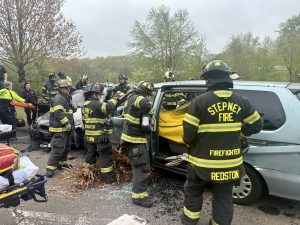
Dyson called in firefighters to secure the BMW, preventing it from sliding down the embankment, and to extricate victims trapped inside the vehicles. He also called for ambulances to assess and treat patients.
EMTs and firefighters had to get 23 people out through the rear emergency door of the school bus, because the side door was blocked.
Screaming children
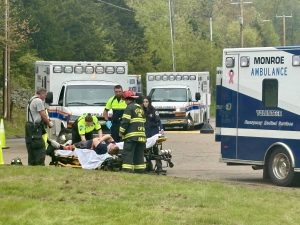 Condon arrived with the second EMS unit. “On the radio, we heard children screaming in the background,” he said. “We all looked at each other in the car and thought, ‘is that people screaming? They went all out on this.'”
Actors playing the roles of injured crash victims and concerned parents heightened the realism and tension emergency responders have to work under, according to Condon.
Sergio Rodrigues, a Monroe firefighter, said his unit arrived to hear kids on the bus “screaming at the top of their lungs” and to see parents banging on windows, while trying to get inside the bus.
“That was traumatic,” Rodrigues said, praising the realism of the mass casualty simulation.
Because the drill, which was held on May 4, involved a school bus, it threw a curveball to Monroe’s EMS volunteers. While ensuring every patient received the proper care, one thing that was different, according to Condon, was the task of getting children’s names.
“I had to call the hospital while figuring out people’s names,” he said. “It was something we talked about after. Parents just want to know where their kids are. For us, we just want to make sure they’re treated, not to know what their names are.”
“The concerned parents made it real,” Condon added. “They played the part very well, wanting to know if their kids were okay and what hospital they were going to.”
Kobza said, “the safety of our students, staff, and community is our highest priority, and drills like these play a critical role in ensuring we are prepared to respond effectively in the event of an actual emergency.”
After assessing the scene, Kobza said school officials tried to gather the information need to communicate effectively with the community, especially parents.
“This was challenging in this context, because emergency services is trying to triage as quickly as possible,” he said. “Their mission, while critical, is different from our role where we are trying to get accurate information out as quickly as possible. We have taken this back to our administrators and the health and safety committee to increase our preparedness in such a situation.”
Others participating in the drill included All-Star Transportation of Monroe, the Board of Education, the Monroe First Selectman’s Office and the Monroe Health Department.
A different mindset
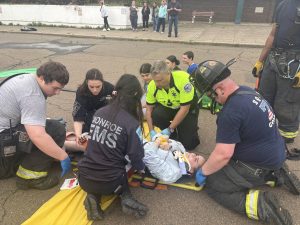 In a mass casualty response, emergency medical responders are trained to do a rapid assessment and move on, according to Condon. In the drill on May 4, Monroe’s responders tended to 30 patients, with mutual aid from Easton and Trumbull EMS.
“You have to quickly see if there is any bleeding on a patient and if you can open an airway,” Condon said of the patients struggling to breathe.
If a patient needs CPR during a mass casualty, emergency responders often have to check on others who may be at risk of bleeding out, so the rules are to move on and come back to the patient.
“The thought process changes,” Condon said. “It’s hard to leave the patient you’re with. It’s scary. It’s hard to talk about and think about. If you perform CPR on the first person you see and other kids are bleeding out … you could have done life saving interventions on others.”
During the drill, Condon said his role was to command and delegate.
“I caught myself multiple times trying to grab a stretcher and help a patient, and I’d say to myself, ‘wait, that’s not my job,'” he said of the adjustment.
Part of the assessment is dividing the patients into categories by color. Red is for patients who need immediate life saving treatment, yellow patients’ care can be delayed, green are minor injuries, and black and white zebra is for patients unlikely to survive due to the extent of their injuries, the level of available care or both.
“I yelled first thing, ‘if you need medical attention, walk to the green area,'” Condon said of his arrival at the scene. “If a patient can walk there, they’re not as critical.”
After the drill, responders received a report that one of the red patients died at the hospital.
Chain of command
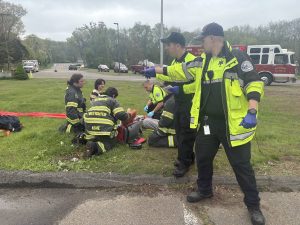 Dyson set up a command post and assigned leadership roles. Chris Doyle served as the chief’s aide, Monroe Deputy Fire Chief Joe McNellis was in charge of operations — the extrication and care of patients.
“He and I had a dedicated radio channel, so every 30 seconds he communicated to me the status of the operations,” Dyson said of McNellis.
On a separate radio channel, Dyson stayed in contact with the Southwest Regional Communications Center, sharing information on the status of the operation and relaying what resources they needed.
Doyle made a timeline of events on a board, with notes and diagrams, throughout the operation.
Stepney Fire Lt. Samantha Kearney served as the safety officer, ensuring all firefighters properly used protective equipment such as safety glasses and hand protection during the extrications.
Stevenson Fire Chief John Howe was the liaison between the EMS and school officials. “He would come to me with that they needed,” Dyson said.
Dyson said he and Howe worked together to determine the whereabouts and conditions of every patient, adding it took about 15 minutes to gather the information on one female student.
All hands on deck
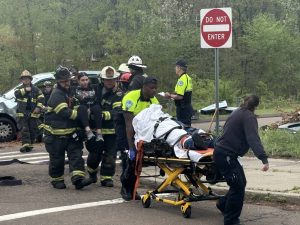 The Monroe, Stepney and Stevenson volunteer fire companies received mutual aid from the Long Hill Volunteer Fire Co. in Trumbull. The Monroe Fire Department’s Womens’ Auxiliary and Bud’s Truck and Diesel Service also participated in the drill.
The event provided valuable training, according to Sergio Rodrigues, who became a firefighter just two years ago.
“It’s good to have experiences like this because, even in a small town, something like this could happen,” he said. “Having these high stress situations, especially for our young guys, it develops our character and helps us improve our skills, so we can be calm during a call.”
When they first arrived on the scene, firefighters used a new grip hoist tool to stabilize the BMW atop the embankment. “I helped them set that up, then worked on extrication,” Rodriguez said.
After helping extricate people from the sedan, Rodrigues was assigned to extricate patients from the minivan.
Once the extrications began to wind down, Dyson ordered firefighters with medical training to report to the command post, so he could assign them to an EMS role.
Rodrigues, who recently obtained his EMT license, joined the six-to-eight firefighters at the command post. Dyson also assigned another six firefighters to assist EMS with moving patients to safety.
No one was standing around, Condon said, adding one firefighter passed out water to those who needed it.
“The good thing about the drill is it showed how my skills improved,” Rodrigues said. “Last year, I was relatively new, so it made me realize how far I’d come.”
Right down to the fake blood
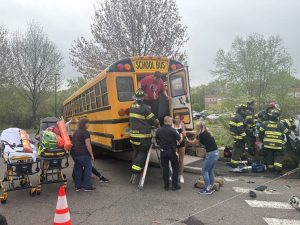 Monroe Fire Chief Kevin Catalano, the drill coordinator, organized the mass casualty exercise, an enormous undertaking involving 15 organizations, two businesses, and over 100 individuals, including 40 firefighters, 25 EMTs and a paramedic.
Fake blood and simulated moulage injuries were applied to many of the actors playing the roles of victims, who were told to scream for help to add to the realism and create more stress for first responders.
Prior to the drill, all information was kept confidential from first responders, adding the element of surprise, according to Catalano.
“The exercise was very successful and was our most complex mass casualty exercise to date,” he said. “Our first responders worked very well together and efficiently rescued, assessed, treated, and packaged for transport a very large number of injured individuals. The participation by our mutual aid agencies was instrumental in allowing us to execute this simulation.”
“Kevin Catalano, he put his heart and soul into this,” Dyson said. “I can’t imagine the hundreds of hours he put into this. He even arranged a lunch for over 120 people.”
“I really give props to Chief Catalano,” Rodrigues said. “To be able to scale the drill having over 120 people involved takes a lot of work, so I’m proud of us and glad we had the experience to do it.”
After the drill, everyone involved assessed how they did and pinpointed areas for improvement.
“We were all impressed with how well everything went,” Dyson said of the overall response.
“Hopefully, we never have a situation like this,” Condon said. “I think everyone who participated on May 4 would say they’re better prepared now than they were the day before the drill.”
All respectful comments with the commenter’s first and last name are welcome.