MONROE, CT — Kevin Reid, who many know through his public service as a Monroe Town Councilman, teamed up with his daughter Mackenzie’s college soccer coach to write a book about raising your child “from her first youth soccer game to Division 1 college athletics, and doing it without losing your mind or your relationship along the way.”
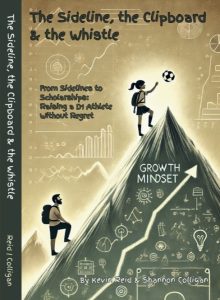
Reid and Fordham University Assistant Soccer Coach Shannon Colligan penned, “The Sideline, the Clipboard and the Whistle: From sidelines to scholarships: Raising a D1 athlete without regret.” The 286-page independently published paperback has already sold 102 copies, according to Reid.
Kevin and Amie Reid’s 19-year-old daughter will soon be embarking on her sophomore year at Fordham, where she plays center back on the women’s soccer team and is studying to be a sports psychologist.
As a parent, Reid said it is important to let your child develop a love of the game early on, before helping them more when they are older.
“Your job is to help your kid be the best that they can be,” he said during an interview at Starbucks in Monroe recently. “The energy you give out comes back to you.”
Reid also expressed the importance of letting coaches coach and not to try to shield your child from setbacks along the way.
 “Let them experience pain, defeat and errors, because that adversity will build their character and resiliency,” Reid said.
Even though the book originated with Reid sharing his experience as a father whose daughter had an aspiration to be a D1 athlete, he said the book can apply to any parent with a son or daughter who is involved in an extracurricular activity.
“The Sideline, the Clipboard and the Whistle” can be purchased on Amazon.
Below, Reid and Colligan answer questions about their book.
What inspired you to write this book — and why now?
Reid: I wrote my sections of the book as a dad who lived every mile of this journey. From the first time I tied her cleats to the last time I drove her to college soccer, I saw how easy it was to get caught up in the dream — and how hard it was to stay grounded.
My perspective is personal. Emotional. It’s not about being an expert in sports. It’s about being honest about what it means to parent a child with big goals. I made mistakes, I learned as I went, and I needed a place to tell that story — not just for me, but for every other parent standing on the sideline wondering if they’re doing it right. This book was my way of saying, ‘You’re not alone. Let’s figure it out together.”
Colligan: I wrote my sections from the other side of the whistle. As a coach who’s worked with hundreds of athletes and families, I’ve seen patterns — both good and bad — repeat themselves year after year. I wanted to give parents the kind of insight most never get: what we’re actually looking for as coaches, how we make decisions, and how your child’s development is affected by what happens off the field just as much as on it.
My voice is there to be clear, direct, and constructive. I wanted to speak to the parents who care deeply but might be missing the bigger picture. This was my way of saying, “Here’s what your daughter needs from all of us — including you.”
Reid and Shannon said they wrote the book together, so readers could experience both sides of the journey.
The book talks a lot about not just raising your daughter, but “raising the whole system that supports her.” What does that mean?
Reid: Yeah, that line’s actually one of the most important in the entire book. Because the truth is, raising a high-level athlete — or just a great kid, really — can’t be done in a vacuum. You’re not just parenting your daughter, you’re influencing everything around her. The team she’s on. The parents in the stands. The coaches trying to do their jobs. It all connects.
We’ve all seen it — that parent who’s all-in on their own kid, but they’re not invested in the bigger picture. They question every coach, cheer only when their kid scores, and treat the team like a vehicle to their daughter’s success.
But what I learned over time, sometimes the hard way, is that when you pour energy into the full system — when you support other kids, show respect to coaches, help build a positive sideline — that’s when your daughter truly grows.
So when we say ‘raise the whole system,’ we’re talking about showing up for more than just your kid. It means investing in the coach’s vision. It means encouraging teammates. It means building a village that your daughter can thrive in. Because no kid makes it to the next level on their own — and no parent should try to do it alone either.
That’s really what this book is about: helping parents shift from tunnel vision to team vision.
You introduce this idea of “Sherpa Parenting.” What’s that all about — and how is it different from being a helicopter or lawnmower parent?
Reid: Sherpa Parenting really came out of this idea that we all want to help our kids climb as high as they can — but we’re not supposed to climb it for them.
Think about an actual Sherpa in the Himalayas. They carry weight, they provide support, they know the terrain, but they’re not the ones standing at the top of the mountain holding the trophy. Their job is to make sure the climber earns that moment, and gets there safely, with the strength and knowledge to come back down, too.
Now compare that to what we often see in youth sports: helicopter parents hovering over every decision. Or lawnmower parents mowing down every obstacle before their kid even has a chance to deal with it. The truth is, those approaches might get short-term results, but they don’t raise resilient athletes. Or strong people.
Sherpa Parenting is about walking beside your kid — not ahead of them, and not dragging them behind you. It means preparing them mentally and emotionally, not just driving them from practice to practice. It means knowing when to step in, and more importantly, when to step back.
That mindset changes everything. It gives your daughter room to grow, to struggle, to develop character. And it gives you a role you can actually sustain — one that doesn’t burn you out or create resentment.
So for us, Sherpa Parenting became a central theme in the book. It’s what we wish more people understood about raising a competitive athlete without losing your mind. Or your relationship with your kid.
There’s a quote in your book, “The ride home can build her up or break her down.” Can you talk more about that?
Reid: Yeah, that line came from real experience — and probably some mistakes I had to learn from. The ride home after a game is one of the most emotionally fragile moments a kid goes through. Whether she played great or struggled, her brain is wide open. She’s raw, processing everything — how she played, what the coach said, whether she feels proud or embarrassed. And in that moment, whatever a parent says can either lift her up … or cut her down without even meaning to.
We think we’re helping when we start analyzing — “Why didn’t you shoot?” “You looked tired.” “Next time hustle more.” But even if our intentions are good, what she hears is: “You weren’t good enough today.” And it chips away at her confidence and her love for the game.
What I learned, and what we try to share in the book, is that the ride home should be sacred. It should be a safe space. Sometimes all she needs is silence. Or a snack. Or for you to say, “Loved watching you play today.” That one sentence can be more powerful than a 10-minute critique.
Our job isn’t to coach from the front seat. It’s to be her biggest supporter when she’s still figuring herself out. That’s what builds trust. That’s what keeps her coming back to the game the next day with her head held high.
A lot of the stories in the book are personal. Was it hard to be that vulnerable — to admit mistakes and missteps as a dad?
Reid: Honestly, yeah. At first it was hard. No one really wants to shine a light on their worst sideline moments or the times they got it wrong. But I realized pretty quickly — if I wasn’t willing to tell the truth, this book wasn’t going to help anyone. Because the truth is, we’ve all messed up as parents. We’ve all said the wrong thing in the car ride home or overreacted after a tough game. The only difference is whether we admit it and learn from it.
I wanted this book to feel like sitting down with a friend — someone who’s been through it, who can laugh at himself a little, and who genuinely wants to help you avoid some of the traps. So yeah, I had to swallow some pride. But being vulnerable made it real. It gave me a chance to say, “Here’s where I blew it — and here’s what I wish I had done instead.”
I think that’s why the book resonates. It’s not a manual. It’s not “10 things you need to do to be the perfect sports parent.” It’s a story. A lot of stories, actually — from both my side and Coach Shannon’s. And it’s honest. That’s what makes it work. That’s what lets parents see themselves in the pages.
Why did you decide to include Coach Colligan’s voice — and how did the two of you collaborate?
Colligan: You know, when Kevin first came to me with this idea, I said the only way I’d be part of it is if we could be completely real. Not just about the kids, but about the parents, the coaches, the whole environment these athletes grow up in.
I’ve been coaching for a long time now, and I’ve worked with hundreds of girls and their families, from rec leagues all the way to Division 1 recruiting. And what I’ve seen over and over again is that the families who truly thrive — the ones who raise grounded, confident, resilient kids — are the ones who understand that this journey takes more than talent. It takes perspective, patience, and support from all angles.
Kevin brings the parent’s heart. I bring the coach’s lens. We wanted to braid those two perspectives together so readers could see the full picture — not just what happens in their own car or kitchen, but what coaches see, what teammates experience, and how all of that shapes a player’s growth. That’s why we wrote in our own voices, with space to reflect separately. We didn’t always agree. And that was the point. Growth happens in the tension sometimes.
The collaboration was really natural. We’ve known each other a long time, and we’ve both been through the highs and lows of youth sports. So this book became a kind of shared truth-telling — a way to bridge that gap between parent and coach, and hopefully, to help other families navigate this world with a little more grace.
Tell me about the “Pre-Game Clipboard” and “Post-Game Talk” structure. Why did you and Coach Colligan choose to speak separately in the book — and what does that mirror about real life in youth sports?
Colligan: From the beginning, we knew this book needed two lanes — one for the parent experience and one for the coaching perspective. Kevin’s story takes readers inside the emotional ride of being a dad raising a daughter through the soccer system. My role was to stand on the sideline of that story, just like I would in real life, and offer clarity, perspective, and some steady guidance. That’s what the “Pre-Game Clipboard” and “Post-Game Talk” sections are meant to do.
I wanted parents to be able to pause after each chapter and ask, “Okay, what does this mean for me? What can I do with what I just read?” My goal wasn’t to preach or correct anything Kevin wrote — it was to expand on it. To zoom out a bit and say, “Here’s what this might look like from a coach”s point of view, and here are some ways to stay grounded.”
I’ve seen parents unintentionally derail their child’s experience just by not knowing what’s really going on behind the scenes. These sections are my way of walking beside them, pointing out the potholes, and helping them be the kind of support their daughter actually needs.
Separating the voices also models something we want parents and coaches to do in real life — listen to each other, reflect, and come back stronger. It’s okay if we don’t always see things the same way. What matters is that we’re pulling in the same direction.
Do you think youth sports culture is getting better or worse?
Reid: I think it’s getting louder, for sure. There’s more noise, more opinions, more videos, more reels, more shouting on the sidelines. But whether it’s actually better or worse — that really depends on where you’re standing.
I’ve seen some incredible progress, especially in how we talk about mental health and coaching with empathy. But I’ve also seen a growing obsession with early specialization, rankings, and the fast track to a scholarship. That part? That’s getting worse.
What scares me most is that we’ve turned youth sports into a pressure cooker for families — not just kids. There’s this sense that if you’re not doing everything, all the time, you’re falling behind. Parents are panicking, kids are exhausted, and nobody’s really enjoying the ride.
That’s what the book tries to get at. It’s not just about the soccer or the goals — it’s about the environment we’re creating. Are we raising a good athlete, or are we raising a good human who happens to play sports?
So yeah, it’s louder. But volume isn’t the same as progress. We need more people willing to turn the volume down and actually listen — to their kids, to the coaches, and to what the game is really teaching us.
You’ve got a whole section about the “fast-track fallacy” — where parents try to shortcut the system. What do you want people to take away from that idea?
Reid: The fast-track fallacy is really a cautionary tale. It’s this belief that if you just train more, spend more, specialize earlier, or jump teams constantly, you’ll outpace everyone and land that golden ticket — the offer, the roster spot, the scholarship. But what we’ve seen, time and again, is that shortcutting the process usually ends in burnout, broken confidence, or a kid who walks away from the game completely.
What parents don’t always realize is that growth in sports — real, lasting growth — doesn’t happen in a straight line. It’s messy. It’s full of plateaus and setbacks. And the kids who learn to stick with it, to show up on hard days, to deal with failure and still keep going — those are the ones who make it. Not always to the top level, but to adulthood with resilience and character.
The fast track often robs them of those experiences. It’s like building a house and skipping the foundation — sure, it might look great for a while, but when pressure hits, it collapses. We wrote that section of the book to remind parents that it’s not about accelerating your kid’s path. It’s about preparing them to walk it with strength, integrity, and purpose.
You talk about something called the ‘Law of Conservation of Energy’ when it comes to parenting. That’s a big concept — what does it mean in the context of youth sports and raising kids?
Reid: Yeah, this one came to me over time — and honestly, a lot of reflection. We all remember from high school science that energy can’t be created or destroyed, just transferred or transformed. Well, I started seeing how that applies to parenting, especially in youth sports.
Every bit of energy we bring — whether it’s pressure, anxiety, micromanagement, or encouragement, belief, patience — it all goes somewhere. It either builds the space around our kid or weighs it down.
If I’m overly intense, even if I mean well, that tension doesn’t disappear. It seeps into the car ride, the sideline, the dinner table, the way she looks at herself. Same with positivity. If I bring calm belief into her world, that sticks, too.
We think we’re just managing our own emotions, but our kids are absorbing that energy constantly. Their teammates feel it. Coaches feel it. It becomes part of the air around them. So the law became this kind of anchor for me. Before reacting or pushing or advising, I ask myself — what kind of energy am I introducing here, and what’s it going to do once it leaves me?
That’s what the law means in the book. It’s a reminder that parenting isn’t just about what we say or do — it’s about the emotional current we create. That current either lifts the athlete or quietly pulls them under.
Who should read this book? Is it just for soccer parents — or does it go beyond that?
Reid: It’s a fair question, because on the surface it looks like a soccer book about a girl’s journey. And yes, the backdrop is female soccer and our daughter’s climb to Division 1. But the book is really about something much deeper — it’s about parenting under pressure, managing your own expectations, and guiding a child through something they love without losing your connection to them in the process.
The principles apply whether your kid plays baseball, dances, runs track, or is passionate about anything that involves development, competition, and identity. It’s about how we show up as parents, how we build character instead of just chasing outcomes, and how we partner with coaches and teammates to create something healthy around our kid.
I’ve had boy moms and dads reach out and say, “This is exactly what we’re going through with our son.” I’ve had people who aren’t even sports parents tell me it helped them think about how they support their child’s passions — music, theater, academics. The framework is universal. If you’re raising a child in today’s intense, comparison-driven world — there’s something in this book for you.
So no, it’s not just for soccer parents. It’s for anyone trying to raise a good human without losing themselves — or their relationship with their kid — in the process.
What’s the one piece of advice you wish someone had given you when this journey first started?
Reid: I wish someone had told me this isn’t just about her journey — it’s about mine, too. That how I show up matters more than how she performs. That my job isn’t to push, or fix, or engineer the perfect outcome. It’s to walk beside her, support the team around her, and protect her love of the game.
I wish someone had told me that the real win is raising a daughter who still wants to talk to me after all this is over. Who knows I had her back, even when she struggled, even when it didn’t look like the dream was going to come true.
The truth is, if I had understood early on that parenting a serious athlete is more about stewardship than strategy, I would have done some things differently. Not everything, but enough to know that mindset matters. You’re not just raising a player — you’re raising a person. And the way you invest your energy, the way you show up after a loss or when she gets benched, those are the moments that shape everything. No highlight reel will ever show it, but your kid will remember it forever.
All respectful comments with the commenter’s first and last name are welcome.