MONROE, Conn. — Greg Smith grew up across the street from the Stratford Police Department, sparking his interest in police work at an early age.
“I saw cops every day, so I did become fond of it,” Smith said of law enforcement. “I went to school for criminal justice at the University of New Haven. I wanted to do something federal, but in the ’90s there wasn’t much available in federal law enforcement at the time.”
Instead, Smith, 54, went on to become a police officer in Monroe in January of 2001, moving through the ranks over the course of his 25-year-career. He served as a patrolman, a school resource officer at Masuk High School, a sergeant, a lieutenant assigned to patrol, then to captain, a title that changed to deputy chief last year to more accurately reflect the role of the Monroe Police Department’s second in command.
On March 20, he will retire and go on to serve as director of public safety and emergency management at St. Vincent’s Medical Center, which is part of Hartford HealthCare.

Police Chief Keith White said the Monroe Police Department is about to undergo one of its biggest changes in personnel in many years, which will include the position of deputy chief.
“I was here his whole career,” White said of Smith. “We’ve worked together for 25 years in various roles in the department. In his current role, he was a great asset to the department and to my office. The best thing about me and him is we kind of have the same thought process, so I have confidence in his decision making. In my absence, he had full authority to run the department.”
“He will be missed,” White said. “His reliability was something I’ve grown to count on and I wish him well in his new endeavor. Greg has always served the town of Monroe and the police department in a professional and respectful manner.”
Among the highlights of Smith’s career, he:
- Received an award from Mothers Against Drunk Driving (MADD) as a patrolman for his enforcement of DUI violations in Monroe.
- Became a full-time member of the Monroe Police Department’s Accident Reconstruction Team after successfully completing the six week training requirement.
- Served as commander (and previously as entry operator, assistant team leader and assistant team commander) of the Southwest Emergency Response Team, which is the regional SWAT team comprised of police officers from area towns, including Monroe.
- Earned a Master’s degree in police administration from Sacred Heart University.
White said Smith also attended the administrative officers course at the Southern Police Institute at the University of Louisville. The 480-hour-course is designed to develop informed and competent law enforcement managers capable of assuming positions of leadership within departments, according to White.
“He was always viewed as a leader in the various roles he held with the department,” White said.
Back on track
Smith said his initial interest was in working for the Drug Enforcement Administration (DEA) or the Bureau of Alcohol, Tobacco and Firearms (ATF).
“I remember scoring a 99 on the test and getting a letter saying it wasn’t high enough,” Smith said of how competitive the field was.

After college, Smith said he got sidetracked for nearly six years, working in commercial moving and office furniture, before deciding to apply for a municipal police officer position.
“I just started thinking of where I grew up and seeing them every day,” he said of the Stratford police officers, “and I always respected law enforcement. My wife said, ‘let’s do it.’ It wasn’t easy. We were married with two kids and a mortgage. I live in Orange. I went to the police academy in Milford, so I could be home every night.”
Smith said his wife Dana had always supported him throughout his career. The couple has three grown children, sons Jacob and Alec and a daughter, Meghan, a granddaughter and another grandchild on the way.
“Monroe was the first police department I applied for and the first that hired me,” Smith said of the only department he worked for in his career.
Smith said a desire to help people in their daily lives spurred his decision to become a police officer. Though police officers often interact with people during the toughest times of their lives, Smith said he felt fortunate to work in Monroe, whose department emphasizes community policing.
Several events in town offer positive interactions with residents, from the Penguin Plunge and Tip-A-Cop to Monroe’s Night at the Park.
“It’s always something new every day,” Smith said of police work. “For 25 years, it’s never been the same.”
He said the hardest thing about being a police officer is time away from family and friends, because oftentimes a bad storm, an emergency call or a major case can lead to missing important life moments like Christmas Day, graduations or a child’s game or recital for example.
“You never know when you’ll be called in,” Smith said. “I don’t think people appreciate how much of your life is spent here and how many life moments you miss.”
Proudest moments
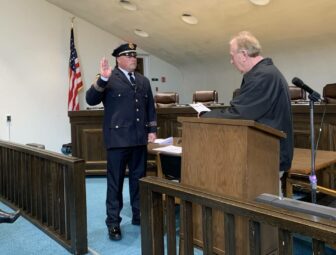
Smith said police officers never know how what they do will impact someone else’s life or how important that impact may be.
“Anytime somebody would come up to me and thank me for something small I did for them, those were always proud moments,” he said. “It could be as simple as somebody who was broken down that you helped, or someone you arrested, who turned their life around.”
Among Smith’s proudest moments is how the Monroe Police Department responded after the town reopened Chalk Hill School for Newtown students following the tragic Sandy Hook Elementary School shooting in 2012.
“Almost the entire department was working that day,” he said. “Everybody was volunteering to do things. I was the road supervisor. Dozens of cops from other towns were helping. Roads were closed.”
Smith said he made sure everything was in place, officers had what they needed, and took breaks during their shifts.
“I was very proud of the department,” he said. “It was a cold day and officers were standing on the driveway for buses, checking I.D.s — just the response of the rank and file that day.”
During his 25 years, Monroe had two police chiefs, John Salvatore and Keith White, completed a renovation and addition of the police station, and its officers worked through blizzards and hurricanes, and investigated fatal crashes, suicides and crime scenes.
“Probably the toughest thing to work through was COVID,” Smith recalled. “Every day was different. There were staggered shifts. Everything was such an unknown and changed drastically. It was a challenge to keep our staff as healthy as possible.”
“We maintained 24/7 coverage during that,” he said of the pandemic. “We never stopped responding.”
Another memorable time was responding to the major floods that hit the region three years ago, according to Smith.
Making a difference
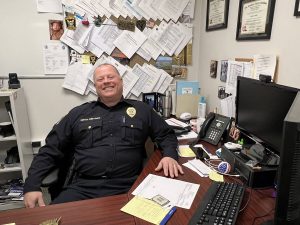
Smith strove to move up through the ranks during his career. “I always thought I had good leadership qualities,” he said. “I wanted to make sure things were done right. I always wanted to be in charge.”
However, he said it was about more than just earning a title. “I always wanted the opportunity to help make things better for the people I work with,” Smith said.
As a sergeant, Smith said he had the opportunity to mentor younger officers, while motivating and helping them reach their own career aspirations, and to be a supervisor and provide training for people.
“I always found great pride in seeing somebody who worked for me or I had a hand in their development, being promoted,” he said. “I find pride in that.”
“But I really enjoyed my years as an executive officer, being able to directly impact something almost immediately on things,” Smith said, “to get something they need. Having the ability to say, ‘that sounds good. Let’s do it. Go for it.'”
As he moves on, Smith said the relationships are what he’ll miss most.
“Without good people around you, you could never do this job for 25 years,” he said. “Obviously, you miss the people you work with and, as I moved up the ranks, I got to know people upstairs and in the schools and in the town that overwhelming supports you.”
“Our main job is to run this place, but also to help people take over, to continue making it a better place,” Smith said. “Although it’s sad in some ways, I’m excited about the department and I think we’re really positioned to keep the department moving in a positive direction. I feel good that I think I’m leaving the department in a better place than when I walked through the door in 2001.”
All respectful comments with the commenter’s first and last name are welcome.