MONROE, Conn. — When someone found a feral cat colony beneath their porch on Cottage Street during the COVID outbreak six years ago, Andee Bennett and Lisa Pinto responded to a post about it on the Monroe CT Residents Facebook page, and Bennett brought her traps to help. The incident led to the founding of the Monroe Emergency Operation for Whiskers (MEOW).
“I ended up capturing seven adult cats and three kittens,” Bennett recalled. “I then fostered and tried to find homes for them. We got homes for two of the younger kittens that could be socialized and the other one was neutered and released, because it was wild.”
This is called TNR — trap, neuter, release — a process meant to prevent feral cat populations from growing out of control. If not for the rescue that July, Pinto said the seven cats could easily have grown to 50 by the end of the year.
“A mother can be impregnated more than once in their heat cycle,” Pinto said during a recent interview at the Starbucks on Monroe Turnpike.
“And they can become impregnated within 16 to 20 weeks,” Bennett added.
“Once the kittens start to wean off, within a month or two the mother will be in heat again,” Pinto said.
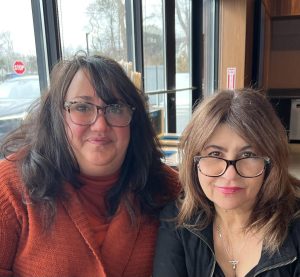
Bennett and Pinto both have a long history of helping cat rescues and Pinto has fostered kittens. As feral cat populations continue to grow in the region, the friends decided to start MEOW to address the issue in a more organized way.
MEOW’s Facebook group launched on Jan. 30 and within the first three days it grew to 75 members. As of Tuesday afternoon, membership stood at 113. In its first two-and-a-half weeks, MEOW responded to four cases and 11 cats.
“This just stemmed from us seeing an uptick on the Monroe CT Residents’ page of people saying they are seeing more stray cats than ever before,” Bennett said.
“I would say it’s a growing problem for every Connecticut community, not just our own,” said Monroe Animal Control Officer Gina Gambino. “Where there is a human population that is growing steadily in density, there usually tends to be a growing feral cat population. Domestic animals that become unsupervised strays, often reproduce and spread diseases at astounding rates.”
Connecticut’s Animal Control Officers primarily enforce state statutes and local ordinances related to domestic animals such as dogs, cats, and other abandoned domesticated species that are kept as pets, such as rabbits and reptiles, according to Gambino.
She said most municipal animal control agencies in Connecticut generally do not have the resources to impound stray or feral cats and therefore cannot accept these animals into their facilities. Doing so would either paralyze these agencies or require a 10-fold increase in the scope of its services, Gambino said.
Gambino said well-intentioned residents, who feed animals in their yards, can sometimes contribute to feral cat colonies growing out of control.
“At Monroe Animal Control, we fully discourage feeding feral or stray cats in our local neighborhoods, because providing food sources to these animals without a management plan can lead to rapid population growth, neighborhood nuisance complaints (noise, odor), increased disease transmission among our own domestic cats and to other wildlife, and also an increase of native wild birds being too heavily preyed upon by these feral animals,” she said.
“Feeding ferals can also potentially attract wild animals like raccoons and foxes and other mammals that are high-vector species (carriers) of rabies,” Gambino added.
Volunteers, funds needed
 Bennett and Pinto, who are the co-founders of MEOW, are now in the process of forming a board.
“We’re conducting interviews for board positions now,” Bennett said. “I want two treasurers for dual control and two secretaries.”
MEOW is also looking for someone with experience in applying for 501c3 nonprofit status.
“There’s not a big budget in Monroe for cats, so we want to raise money,” Pinto said of potentially having fundraising events such as car washes and bakes sales. “We have a GoFundMe to take care of four kittens and one momma.”
In the meantime, those uncomfortable making a donation to MEOW before it obtains its nonprofit status can contribute directly to New Lease on Life, a spay and neuter clinic in Orange. When you contact the vet, be sure you tell them to attribute the donation to MEOW’s vet fund.
Bennett said New Leash on Life gives MEOW a discount to spay and neuter cats and to give the animals their shots. MEOW is charged $75 per cat for services that normally cost between $500 and $1,000, according to Bennett.
“Their ultimate goal is to reduce the feral cat population in Connecticut,” she said.
The clinic will tip the ear of a cat that is fixed, so if it has to be returned to the wild, people will know it was done.
‘Mild or Spicy’
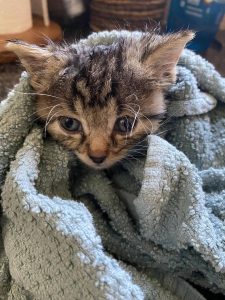 When a cat is trapped, Pinto said the first thing MEOW will do is post its photo on social media to ensure it is not someone’s missing pet.
Though Bennett and Pinto will sometimes make house calls, this will not always be possible due to their own day jobs, said Pinto, who works for First World Mortgage Co.
“We don’t want people to say, ‘I have a cat in my yard. Come and get it,'” Bennett said.
Pinto said this is a community effort. MEOW will lend out its traps and show people how to use it, as well as visit yards to assess situations.
MEOW plans to create a list of volunteers willing to educate people and help them with traps, transport cats to and from vet appointments and help bottle-feed kittens.
Bennett said the organization is in desperate need of people with a spare bedroom or bathroom that can be used to socialize cats, establishing whether the animals are adoptable or must be released where they were trapped.
Pinto said it is critical to release cats that are too wild to become pets in their original habitats, where they know how to find water and food. The women affectionately call cats that cannot be socialized “spicy.”
They said it takes about three days of winding down, before you can start to really determine whether a cat can be socialized. Aside from feeding cats and playing with a toy, simply being in a human’s presence while a volunteer works nearby, or even watches TV, can make a cat start to become more trusting around them, according to Pinto.
If it’s a friendly cat, Pinto and Bennett will help find local rescues to help place them in loving homes.
For information, visit MEOW’s Facebook page, which will soon have a link to an Amazon Wish List for needed supplies as another to help. Those who are not on Facebook, but want to get involved, should send an email to [email protected].