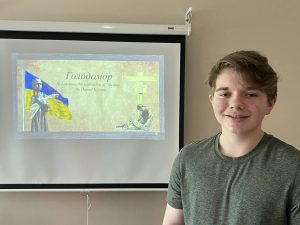
Daniel Kocan, a Masuk High School sophomore, won second place in a contest on a topic close to his heart. Kocan, whose mother emigrated to the U.S. from Ukraine worries about relatives still living there amid missile strikes by Russian invaders. He also knows the long history of suffering the Ukrainian people have endured, including the Holodomor, a famine manufactured by Russia’s brutal dictator Joseph Stalin, which led to the deaths of up to 7 million people from 1932 to 33, though the estimates widely vary.
Kocan is proud of his Ukrainian roots. His mother came to the U.S. with Kocan’s grandmother and brother, and his father came from Slovakia. Every year, Kocan plays music on his accordion, bandura and sopilka at Masuk’s Culture Fair.
“The Culture Fair does mean a lot to me,” he said during an interview with The Sun. “It’s something I look forward to every day, because it’s a rare opportunity to teach other students about this stuff. I always wanted to teach my classmates about the Holodomor. It’s an important part of Ukranian history. It didn’t really fit into any curriculum.”
That was until Emily Woznick, an Honors Contemporary World Issues teacher at Masuk, became aware of a contest run by the U.S. Committee for Holodomor Genocide Awareness.
“We do a genocide research project,” Woznick. “We got an email about the contest and I offered it to all my students, and I sought out Daniel because of what he had done.”
The objectives of the student competition were to learn about the Holodomor, present or publish something about it, and to raise awareness about the Holodomor by making a presentation within an educational or community setting.
Research materials could consist of an essay, newspaper article, short story, play, poem, interview with a Holodomor survivor or descendant, a comparison of the Holodomor to other genocides and/or to Russia’s current war against Ukraine, analysis of the U.N. Convention on Genocide as applied to the Holodomor and current war, and the role of journalists during the Holodomor.
A survivor’s story
In 1932, Stalin forced Ukrainian farmers into collectives and those who refused to turn their crops over to the Russian government, could lose their property and livestock as punishment. Adults caught taking wheat for their families were jailed and children were whipped for the same offense.
Kocan’s presentation includes a YouTube video of Holodomor surviver, Vasyl Tsyba, speaking to children. He said the harvest was bountiful with potatoes and wheat, but the Russian government confiscated food from Ukrainians.
“We had to eat acorns. In autumn, we gathered mushrooms,” he said. “But the winter of 1932-1933 was the toughest time. There were a lot of pigeons. To survive, we ate those pigeons, especially grandpa.”
The government took the Tsybas’ home in the winter, because the farmers did not meet the quota for food it had to give to the Soviet Union. During the period of hunger, Tsyba, who was just a boy, did not realize his family ate their own dog.
“The dog had gone missing and we asked grandpa, ‘where is the dog?'” Tsyba said. “He said that wolves came into the village and ate it.”
“The Holodomor took the lives of over 4.5 million people,” he said. “My life is tough. When I recall these events, I cry.”
In his presentation, Kocan also covered the story of the Kobzari, wandering bards who played the Kobza/bandura. The Kobzari were persecuted for their music.
But Kocan’s project also showed the resilience of the Ukrainian people, especially from the Cossacks, Ukranian freedom fighters who date back to 16th century. He said they were known for horsemanship, military prowess, dance, and skills. The Cossacks proclaimed and fought for independence.
“Throughout history, Ukranians were persecuted a lot,” Kocan said.
“They were under attack by the Polish Empire, the Ottoman Empire and Russia when the Soviet Union had control over that region as well,” said Woznick.
“The Cossacks were Ukrainian warriors who rebelled against these countries over the years,” Kocan said. “They’re Ukraine’s spirit and inspiration.”
Never forget
Like Stalin, Vladimir Putin, Russia’s current dictator, denies the Holodomor ever took place. Russia has even destroyed monuments to the history. The U.S. Committee for Holodomor Genocide Awareness competition among high school students is an effort to keep this history alive.
Kocan said his family is not sure if any relatives were in the part of Ukraine where the Holodomor took place, though they did suffer from Russian oppression when traditional villages were destroyed and family members were sent away.
“They tried to Russify us a lot. They tried to take away our language and traditions,” Kocan said. “That’s why a lot of Ukrainians speak Russian — they were forced to. My main premise was to teach my class how it affected the people, how it compares to other genocides and how we can learn to prevent genocide.”
Woznick said it starts bias and prejudice against a group of people, followed by violence. “We follow the Pyramid of Hate,” she said.
“It definitely killed a lot of Ukrainians, who lived in the regions that were part of Russia,” Kocan said of the Holodomor. “It gave Ukrainians more courage to fight and resilience. As I continued to research the topic, I learned a lot more. I got more of a grip on the topic and how it affected people.”
Of classmates who saw his presentation, Kocan said, “I want them to know the genocide itself, that these are things going on today and we should know history, because history repeats itself.”
Kocan’s second place finish in the contest comes with a $300 prize and Masuk received money for materials to teach students about the Holodomor.
In a teacher feedback form about the project, Woznick wrote:
“Daniel presented in front of my Honors Contemporary World Issues class. Daniel did a fantastic job, not only touching upon the turmoil Ukrainians faced and continue to face, but celebrating the cultural and spiritual resilience of the Ukrainian population. The presentation was very well received as there were many students who asked questions, were curious about the content, and engaged in the conversation. Daniel spoke eloquently, provided ample information, and sparked empathy in his fellow peers.”
Daniel is a very motivated student, who is passionate about Ukrainian history and culture. He is very well deserving of recognition for his hard work.”
“I think Daniel has a unique perspective other students don’t have,” Woznick told The Sun. “He has a passion about sharing his family history. It’s just really refreshing to see Daniel advocate for his culture and history and to teach his peers, because it’s not an easy thing to do. He’s just so excited to share this part of his knowledge and to dive deep into a topic in class.”
“As a teacher, it’s so rewarding to see students take what we’re learning and expand it outside the classroom,” she said.
All respectful comments with the commenter’s first and last name are welcome.