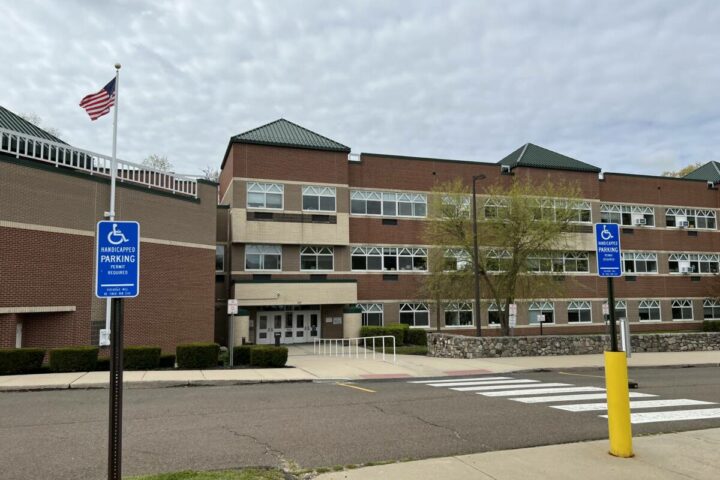
MONROE, Conn. — Close to 50 parents protested outside Town Hall to overturn First Selectman Terry Rooney’s $1.6 million reduction to the 2026-27 budget proposal for Monroe’s public schools Thursday evening, before the Council Chambers filled up for the Board of Finance meeting, with a number of people standing along the walls.
Then the meeting opened with Rooney reading aloud his letter to the board, recommending putting back $1.2 million, reducing the cut to $403,230. The first selectman said some of this could be funded by a drop in the projected health insurance premium increase, from 15 to 12.5 percent.
Though he will have to review his budget, Superintendent Joseph Kobza said the first selectman’s recommendation would allow him to take some of the most unpopular cuts off the table. This means keeping eighth grade at Jockey Hollow Middle School rather than moving it to Masuk High School, keeping the STEM Academy, avoiding staff cuts, and keeping freshmen sports and student clubs at Masuk.

Rooney said, “this administration understands the frustration, the disappointment, and the anger many feel about the reduction of the planned increase to our education budget. When it comes to our children’s future, emotions run deep and they should. Nothing matters more to a community than the opportunities we create for the next generation.”
The first selectman said the request reflects an additional $1.2 million for education above the original $2 million budget increase for a $77.9 million proposal.
“This allows for our community to choose the financial direction of our town by exercising their right to vote on May 5th in the annual budget referendum,” Rooney said.
Now it’s up to the Board of Finance to decide what revisions, if any, to make to the Board of Education’s budget.
“We’re going to strongly consider the recommendation and do all of the due diligence in our workshops with the entire budget,” Board of Finance Chair Rebecca O’Donnell said after Thursday’s meeting.
While a number of parents and educators speaking during the public comments portion of the meeting expressed gratitude for Rooney’s recommendation, many continued to push for the entire $1.6 million to be restored, and some wanted that and another $250,000, which the school board had cut in a vote along party lines.
“I do appreciate all of the public involvement and engagement in this process,” O’Donnell said. “I read every email and tried to respond to all of them.”
A public hearing on the budget is tentatively scheduled for March 31 at 6 p.m.
Picketing outside
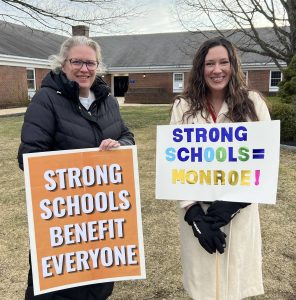
A crowd of education supporters arrived before the Board of Finance meeting, braving the cold and holding up signs with messages like, “Strong Schools Benefit Everyone,” “Strong Schools = Monroe,” “Protect Monroe Schools” and “Don’t Balance the Budget at Our Kids’ Expense.”
Among them was Jen Morrison.
“I’ve been really active in Monroe Schools since my son was in pre-K and I feel people come to Monroe for the schools,” Morrison said. “I have a seventh grader, who will be in eighth grade next year. I don’t think my son should be in high school that soon. I think there are other ways to make things work than cutting education.”
Kelly and Kevin Middendorf, whose son, Logan, 6, is a kindergartener, also participated in the demonstration.
Kelly said, “I’ve lived here since 2013 and in watching the cuts in the education budget over time, I’ve become concerned over staff cuts and the ability to support all the children — especially with increasing enrollment. To me, it’s simple math.”
Support for Monroe’s schools
Many education supporters stepped up to the podium to speak during the public comments portion of the Board of Finance meeting and some participated remotely.
Beyond the numbers, Kelly Middendorf talked about the human element of the school system.
“Tonight is about something much more basic, whether the adults in this room choose to protect the next generation for Monroe,” she said. “I’m going to show you someone,” she added, holding up a photo of her son. “This is Logan. Logan needs some extra support at times and the team at Monroe Elementary has been exceptional.”
Middendorf said the teachers and support staff understand her son and treat him like he’s not a problem to manage.
“They treat him like a child worth investing in,” she said. “That support has changed his trajectory. I wonder how many of you have a story like that and how many children in this room have been lifted up by someone in the schools.”

Middendorf asked other parents to hold up pictures of their children and many lifted copies of photos and cellphone pictures.
“To the members of the Board of Finance and the Town Council, tonight you’ll go home, you’ll close your eyes and I hope that when you do, you think about those faces,” she said. “I hope that you remember them, because the children are watching what the adults in their community choose to do. They’re watching whether we protect them or whether we continue to prioritize their needs.”
Sona Jasani, a mother of three school-aged children, whose elderly parents also live in Monroe, complained of what she sees as partisan excuses by town officials and rhetoric that supporting the town’s schools deprioritizes Monroe’s seniors.
“You have the ability to change the current discourse and show the true character of your leadership,” Jasani said. “Put aside partisanship and support our schools, because our schools are the lifeblood of this town.”
Many parents said a strong public school system benefits everyone, increasing property values and making Monroe a desirable place to live.
Sara Bento, a student representative to the Board of Education, was among the Masuk students who spoke. “Taking away countless opportunities seen as extras will take away from students’ successes,” she said of any education funding cuts.
Jeff Auriemma, the father of three school age children, spoke of a recurring thing he has seen at budget time, a big cut to the education budget proposal, parents speaking out, then some money being put back in. He said the town must invest in its school system amid a growing student population and inadequate school facilities.
Tiffany LoConte, a parent and a first grade teacher at Fawn Hollow Elementary School, thanked the first selectman for listening to his constituents, but agreed with Auriemma about the pattern at budget time, saying it seems like tug-of-war with a big cut, parents coming forward and money being restored.
She said Monroe has the highest teacher-to-student ratio in its District Reference Group, 11 to one compared to the average of 9.7 to one, and that most other districts have shown improvement in math and English language arts, while Monroe is backsliding.
LoConte asked that the entire $1.6 million reduction be restored.
Katie Tolan, a mother of two who started the Facebook Group Monroe Parents for Education, told the finance board her petition to reinstate all of the education funds now has over 900 signatures and high school kids also have a petition.
“We are here tonight promising you we will not fade from this day through all election days to come,” she said.
Dave Walker’s children graduated from Masuk nearly 20 years ago. Now he said he is a senior citizen willing to support the schools for other people’s children. Walker asked that the entire budget proposal go to referendum intact, so voters can decide on it.
Several speakers asked for an advisory question on the referendum ballot saying, “yes just right,” “no too high” and “no too low.”
Mark Zurek said the first selectman’s budget letter says he wants to return $2.7 million from the general fund to the taxpayers. Zurek said this would mean about $35 a month per household. To restore the $403,230 reduction for education, Zurek suggested returning $30 a month to taxpayers instead of $35.
“This will improve education and property values,” he said. “Would you give up a cup of coffee per month?”
Debbie Malewicki, who grew up in Monroe and is raising her son here, said years of underfunding Monroe’s schools has consequences. According to U.S. News & World Report, she said Masuk was the 33rd ranked high school in Connecticut in 2019, before falling to 35th in 2022 and to 56th in 2025.
Masuk ranked 1,708 nationally in 2022, but fell to 3,019 by 2025, she said.
Malewicki turned to the superintendent, who was seated in the front row, and said, “Mr. Kobza, I don’t want your budget restored. I want it increased through the roof,” as the Council Chambers erupted into loud cheers.
All respectful comments with the commenter’s first and last name are welcome.