
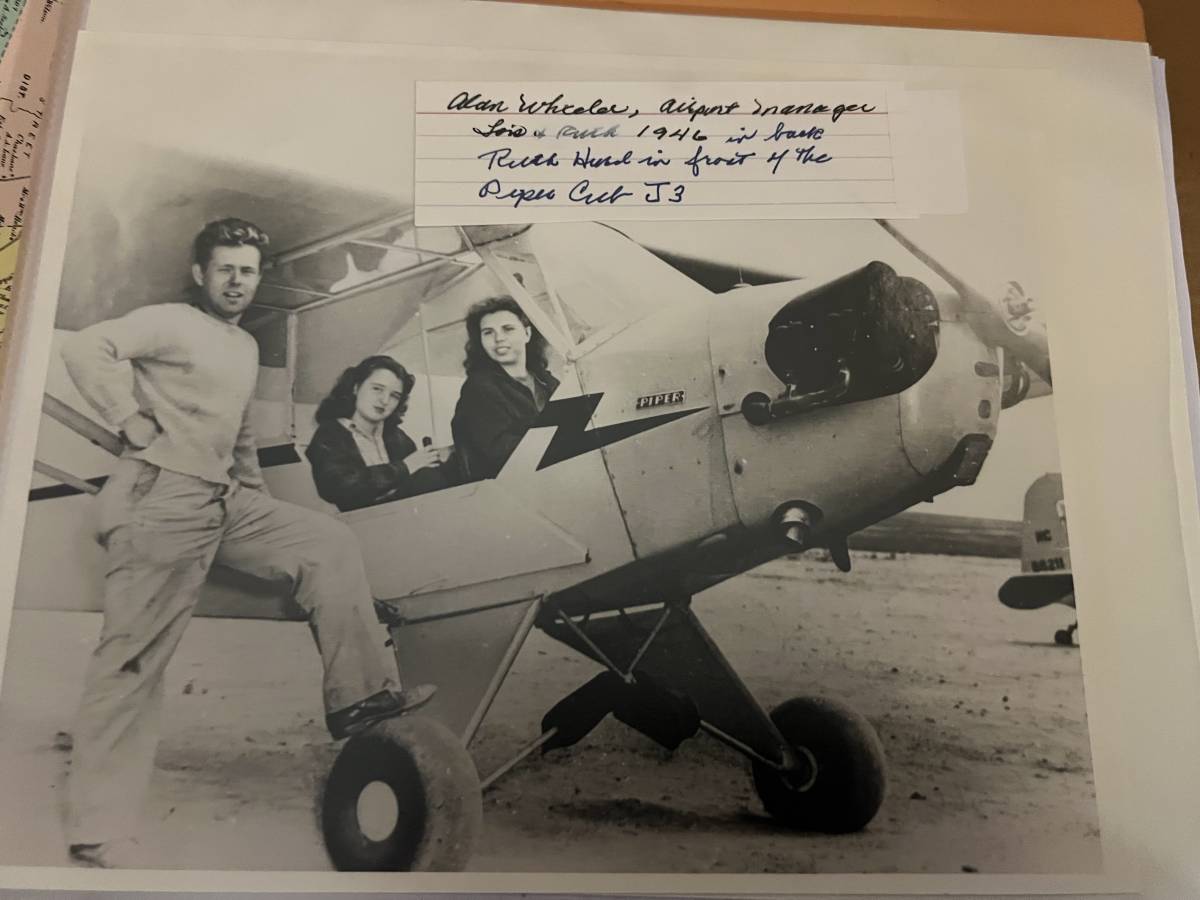
Benjamin Hurd used equipment from his Southbury and Roxbury road building business to start a popular dirt race track on 70 acres of his old family farm on the east side of Moose Hill Road in Monroe, where the roaring engines of cars traveling at speeds in excess of 100 mph was a common sound. But after learning to fly at Stratford Airport in the late 1920s, Hurd was bitten by the flying bug.
He installed headlights on his bulldozer, so he could work at night, transforming the racetrack into a 2,000-foot-long air strip. His daughters, Ruth and Lois, took turns riding along with him as he buried old stonewalls and an old orchard, smoothing out the two ends of the racetrack.
The Monroe Airport and Hurd Aviation Services opened in the summer of 1940 as a training destination for many students seeking a leg up on becoming pilots for in the Army Air Corp, which later became the U.S. Air Force.
Over the years, the airport changed ownership before officially closing sometime in the 1970s.
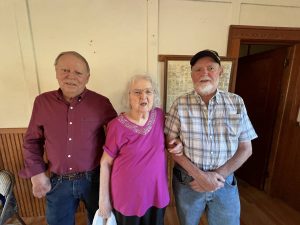
On Friday evening, Lois Hurd Hayden, who now lives in Shelton, told the story of her family’s deep roots in Monroe and of her late father’s airport during Harmony Grange No. 92’s meeting. Her two brothers, John and Ben Hurd III of Southbury, her daughter, Marion Osborne, Edward Nagy and other family members were among the more than 30 people in attendance.
Osborne read some of her mother’s notes aloud.
Hurd family history
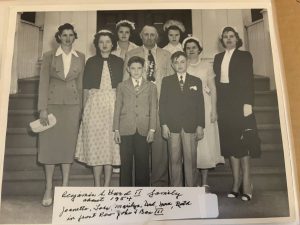
Prior to talking about the airport, Hayden shared the story of her family’s emigration to the U.S.
Around 1635, brothers John and Adam Hurd sailed from England to Windsor on the Connecticut River. After floods and raids from Native American tribes, they joined The Rev. Blakeman and 14 other English families in relocating to what is now Stratford.
“John and Adam Hurd were millers and Adam later moved to Woodbury to be the miller there,” Hayden said. “John set up a grist mill near what is now east Bridgeport’s Old Mill Green. He was also the surveyor to measure out the land.”
Hayden’s family follows the descendants of John Hurd, who was her eighth grandfather. She has ancestors who fought in the Revolutionary War, and many of her relatives settled down in New Stratford, which later became the town of Monroe.
Arnold Hurd bought various pieces of property in Monroe, accumulating more than 200 acres on Old Tannery Road with a large home, a dairy farm, a tungsten mine, a stone quarry and a hat manufacturing shop on Barn Hill Road, according to Hayden’s research.
“The family house is today the large pink house on the north side of Old Tannery Road, just west of the Monroe Center Cemetery,” she said.
Her family had owned a large dairy farm, which Samuel Burr Hurd sold to the Whitney family in the late 1930s. The farm became what is now the Whitney Farms Golf Course on Route 110.
Samuel’s brother, Ambrose Shelton Hurd, was the Grange Master of Harmony Grange No. 92 from 1898 to 1901.
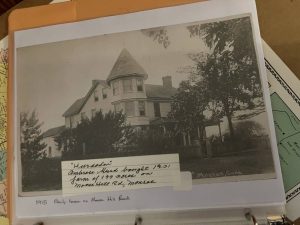 “Since he was the second son, he knew he would not inherit his father’s Old Tannery Road home and farm,” Hayden said, “so Ambrose purchased 199 acres with a house, barns and outbuildings on Moose Hill Road when he married Florence Wales in 1901.”
She said the property’s boundaries today would be Route 110 on the north, Route 111 on the west, down Moose Hill Road to the Jewish cemetery on the south.
“The house is the white Victorian house with the corner turret across from St. John Cemetery,” Hayden said. “It used to have a front porch. They nicknamed the big farm house ‘Hurdsden’ and raised their children there: Benjamin S. Hurd II, and daughters, Frances and Martha.”
“His wife Florence was the daughter of Solon B. Wales and Frances Eliza Sterling of Elm Street,” she said. “Solon was a founding member of the Grange and a state legislator. He helped get electricity and telephones installed in Monroe.”
Benjamin Smith Hurd II married Marion Charlotte Oakley of Bridgeport in 1926.
“Their first daughter, Ruth, was born in 1927 and then I was born in 1931,” Hayden said. “Five more children came later. Growing up, Ruth and I had fun roaming the farm, picking wild flowers and berries, catching pollywogs in the spring, and then sliding downhill during the winter on a hill that became the southern part of Hurd Avenue.”
In 1932 an acre of land at the corner of routes 110 and 111 was deeded from Hayden’s father to Harmony Grange, where its building was built in 1933.
“In 1946 the remaining frontage on Route 110 at the junction of Moose Hill Road was deeded to the Monroe Volunteer Fire Company,” Hayden said.
Lois keeps watch
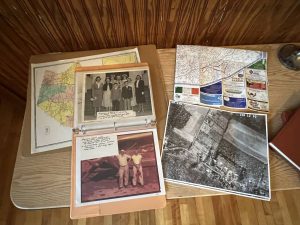
While the Monroe Airport’s hangar was being built, guards were required to keep watch at night.
“Ruth and I took turns being on watch when our mother took her turn,” Hayden recalled. “We also went to the Lookout Tower on Barn Hill to be ‘on watch’ with our mother. Adult guards became deputy sheriffs with 45 mm pistols. That included our mother.”
During World War II, German U-boats were detected off the coast, so in 1942, the U.S. government closed all private airports within 50 miles of the Atlantic Coast, giving only five days notice, according to Hayden.
Her father moved Hurd Aviation Service’s airplanes to Stormville, N.Y., but so did many other flight schools. “The airport was way too crowded, so Ben moved to another airport in Wingdale, N.Y., which had been a farmer’s corn field,” Hayden said.
The Monroe Airport was cleared to reopen in July of 1944, so the Hurd family moved back home.
“Soon the GI Bill was passed and the war veterans were able to take flying lessons,” Hayden said. “It was a busy time and I could attend the navigation classes. I also worked at the refreshment stand. Later, I ran the ‘gas shack’ on weekends and scheduled pilots and instructors with the airplanes.”
“Pilots would use me as a ‘sandbagger,'” she said. “When they needed more weight in the plane, I would ride along. I could be a passenger in the Waco open cockpit biplane in the front seat, while the pilot practiced aerobatics for their upgraded pilot’s license.”
Hayden said she did the same thing for those practicing loops and tail spins in a Piper Cub trainer.
“One day, I saw a pilot do 26 loops,” she said. “I asked him why didn’t he do that with me? So, he took me up in the plane and did 26 loops again! Without extra weight in an airplane during practice, the airplane would react differently from when an inspector was testing the pilot.”
Hayden took flying lessons whenever there was an opening, in preparation for a solo flight on her 16th birthday. But bad weather in August of 1947 led to the cancellation of her flight. “I had waited three years for that special day and it didn’t happen, so I never did fly solo,” she said.
The airport changes hands
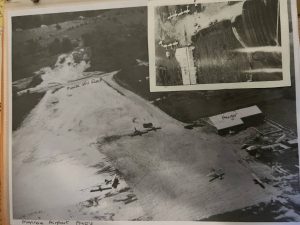
Around 1947, the Monroe Airport was leased to a former Chance Vought test pilot, Ed Sapp, who also had been an instructor for the Navy.
“Ben Hurd had started a lumber business and began selling lots and building small homes for veterans on Moose Hill Road,” Hayden said of her father. “My sister, Ruth, had the first home built there.”
“By the summer of 1950, the new Ruth Street and Hurd Avenue had been built,” she continued. “Our large farm house had been sold and our family moved into an apartment over the lumber company business before a new home was finished.”
She said the lease on the airport was transferred to Connie and Nick Grasso, who had been test pilots for Chance Vought. “They also bought homes on Lois Circle near Jeanette Street,” Hayden added.
Tragedy struck on August 30, 1955, when Benjamin Hurd was killed in an airplane crash in Dover Plains, N.Y.
“The cause of the crash was never determined,” Hayden said. “At the time, he had finished the homes in the Hurd Avenue area and had started to develop a second subdivision off of Barn Hill Road, but due to many court cases, Valley Vista was not finished by our family.”
“After several court dates, we were able to sell the remaining Moose Hill Road airport property to Frank Bero, a commercial realtor from Bridgeport,” Hayden said. “He continued to rent out the land for the airport. After several years, the airport and flying school business closed, and the property was developed for the two cemeteries: St. John and the small Jewish cemetery south of there.”
All respectful comments with the commenter’s first and last name are welcome.


We moved to Ripton Ridge in early ’73. The airport was still in use then. In the warm weather, skydivers would parachute from the planes. They would land in the Jones Farm property. We would sit on our deck and watch the show. Once a skydiver went off course and safely landed in our open field behind the house. But, all too soon, our backyard view of this entertainment ended when the airport closed. However, we now own a family plot in St John’s cemetery.
In the first few years after we bought our first house in Stevenson in ’67 (𝑜𝑟 𝑤𝑎𝑠 𝑖𝑡 ’68? 𝑖𝑡’𝑠 𝑡𝑜𝑢𝑔ℎ 𝑔𝑒𝑡𝑡𝑖𝑛𝑔 𝑜𝑙𝑑) we went to several air shows at the Monroe airport. I was particularly interested in a couple autogyros (sp?) I saw there. And before we knew it, the airport was gone.
I wish we still had that airport. If I built that cemetery, I would have required flat flush mounted head stones so planes could still take off and land… Race course around the outside too….LOL
When drone like, personal flying becomes mainstream, we will wish we had an airport.
My father was a friend of Ben Hurd in the days when grass airstrips were found in many places including Ansonia. My father was also part of a group that operated a small airport on an island in the middle of the Housatonic River in Shelton called Island Airport. I still remember my father being distraught on hearing that Ben Hurd had been killed in a plane crash. I remember he and another friend drove to NY to examine the wreckage. My father also flew some of the submarine patrol flights along the coast. He went on to be an instructor for the Army Air Corps at Thunderbird Field in Arizona teaching Japanes pilots to fly. Ben Hurd was a name I heard often in my youth.