

STRATFORD, CT — After paying it for two decades, consumers only learned of a public benefits charge on their electric bills two years ago, when An Act Strengthening Protections for Connecticut Consumers of Energy required power companies to itemize bills.
State Sen. Ryan Fazio, R-36th, said the charge raises over $1 billion annually, when combining what Eversource and United Illuminating customers pay, and is used to fund 57 government programs. The charge accounts for about 20 percent of electric bills, while costing the average consumer around $670 a year, Fazio said.
According to a Connecticut Business and Industry Association (CBIA) poll, 73 percent of voters support ending the public benefits charge, and 75,000 residents signed a petition in favor of eliminating it.
“There’s a lot of value in really knowing what you’re paying for,” said State Sen. Jason Perillo, R-21st. “Sometimes sunshine is the best disinfectant. So when you open up people’s eyes and you show them the facts, that’s really where you get to see change happen.”
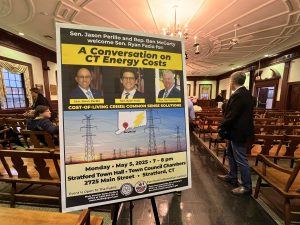
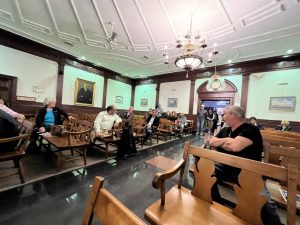
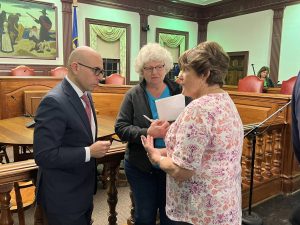
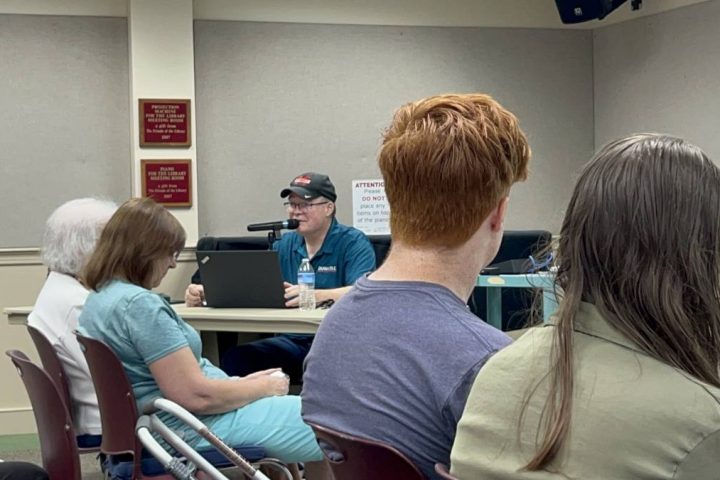
Though they are the minority party in Hartford, Republican legislators are planning to educate the public about the issue through a series of town halls across the state. On a Monday evening, May 5, Fazio, Perillo and State Rep. Ben McGorty, R-122nd, spoke to 23 voters during an event at Stratford Town Hall.
The GOP proposed Senate Bill 647: The Consumers First Act, with measures to lower electricity bills. But the legislature’s Energy and Technology Committee voted against it along party lines.
Nevertheless, Fazio led a presentation featuring Connecticut’s energy issues and the GOP plan at the Stratford town meeting.
“Listen, we’re having this debate in Hartford,” Fazio said. “We haven’t had all the luck in the world the past two years of actually passing what we’ve been arguing for in our energy legislation.”
“My hope is that we continue to persuade our friends on the other side of the aisle,” he said of the Democratic Party majority. “They rejected our plan this year in whole, but maybe we can progressively chip away at it and find some common ground.”

Fazio said the reason he is so optimistic about the ability to pass meaningful legislation is because regular people all across the state are speaking out. “This is now rated as the most important issue to voters across Connecticut,” he said.
Perillo said, “right now there are a lot of conversations on lowering or eliminating that public benefits charge — and we’re only doing it because you knew about it.”
Fazio said the 57 government programs are across many categories, with the top three including subsidiaries for private energy producers (mostly solar), redistributive programs (low income discount and unpaid bills), and energy efficiency programs.
“The ‘public benefits’ are not ending, expiring or going away,” Fazio said.
Rising rates
A screen in the Council Chambers of Stratford Town Hall showed the question: “How do you feel about Connecticut’s Energy Prices?”
A QR code allowed residents to use their cellphones to post one word answers. The screen started to fill up with the words disappointed, frustrated, infuriated, robbed, disgusted, crazy, upset and confused to name a few emotions.
One man in the audience told legislators they could sum it all up with “pissed off.”
“You’re not crazy if you think there’s something wrong with your energy bills in this state,” Fazio said. “Connecticut actually has among the highest, if not the highest electric rates in the continental United States.”
The senator showed graphics in which Connecticut’s rates were consistently among the top two in the continental United States, with Hawaii, an island, the only state consistently higher. He said higher costs “crush Connecticut’s economy, job growth and manufacturing.”
“The electric bills are too damn high,” Fazio said. “We all know it, but it doesn’t have to be this way. It doesn’t have to be this bad. That’s what this grassroots tour across the state is all about: What’s going on? And what can we do about it?”
Senate Bill 647
The Consumers First Act sponsored by Republicans offered “a six-point solution,” including the elimination of the public benefits charge.
They argued that the charge on electric bills frees the government programs it funds from public scrutiny and accountability. Without the charge, they reason, any of the necessary programs would have to be funded by the state budget or bonding process.
Elimination of the public services fee would also lower Connecticut consumers’ annual electric bills by an average of $600 to $700.
The plan calls for “prohibiting the commissioner of Energy and Environmental Protection or any electric distribution company from entering into a power purchase agreement for electricity at a rate exceeding 150 percent above the wholesale price of electricity,” according to Fazio’s presentation.
The Republican proposal would include hydro and nuclear as Class I renewables. This clean energy strategy would force more sources to compete and drive down costs for Connecticut’s Renewable Portfolio program subsidies, thereby reducing consumer costs, legislators said.
Republicans also called for separating the Public Utilities Regulatory Authority from the Connecticut Department of Energy and Environmental Protection (DEEP) to give PURA more independence to check the costs and decisions of the utility companies.
The plan would have eliminated programs increasing demand for electricity, such as incentives like electric vehicle rebate programs.
McGorty, Perillo and Fazio said it is unfair for taxpayers to subsidize consumption by private electric vehicle owners, data centers or any other private entity.
While talking about the need for fairness, a woman at the meeting pointed out that drivers pay a gas tax to fund highway maintenance, while there is no similar charge for electric vehicle owners.
“That’s something being looked at now, because everybody should pay their fair share,” McGorty said.
The sixth point in the GOP plan called for expanding the Natural Gas Reliability Act in Connecticut by finding actionable steps to increase supply of affordable natural gas, including new pipeline capacity.
“The price of energy in New England is heavily influenced by the price of natural gas. Increasing supply will help stabilize the price and increase of reliability, potentially saving residents hundreds of thousands of dollars annually,” according to the plan.
Meeting demand
On Monday, the legislators also discussed another major problem facing the state. Demand for electricity in New England is expected to double in 20 years, according to ISO New England. The three main drivers for increased demand are data centers, electric vehicles and electric heat, Fazio said.
Currently, all new generation is projected to come from wind, solar and battery power.
“Excluding batteries, it’s roughly 80 percent wind, 20 percent solar and virtually nothing else,” Fazio said. “The wind isn’t always blowing. The sun isn’t always shining and the battery technology hasn’t really been rolled out to scale in a commercially marketable way.”
Fazio said these kinds of projects have been plagued with cost overruns.
There has been some good news for the environment in Connecticut, according to Fazio.
New England’s power grid shifted away from two-fifths oil and coal to lower-emissions natural gas, which rose from 25 percent of the grid in 2000 to 51 percent in 2024, he said.
The transition from oil and coal to natural gas led to a 56 percent drop in emissions for New England in the last 15 years, according to the EIA, while cutting down on Greenhouse Gas emissions by half and significantly lowering air pollution.
In his presentation, Fazio said the “fracking revolution” in the U.S. made natural gas more plentiful and affordable, making the state less dependent on oil and coal.
Aside from favoring an increase in gas pipeline capacity, McGorty, Fazio and Perillo expressed support for investing in nuclear energy as a longterm future goal. Though the capital costs are high, they tout it as among the most reliable forms of energy, with zero-carbon air emissions.
All respectful comments with the commenter’s first and last name are welcome.



None of this matters when the majority of the legislature regardless of political affiliation is bought and paid for by the utility companies.