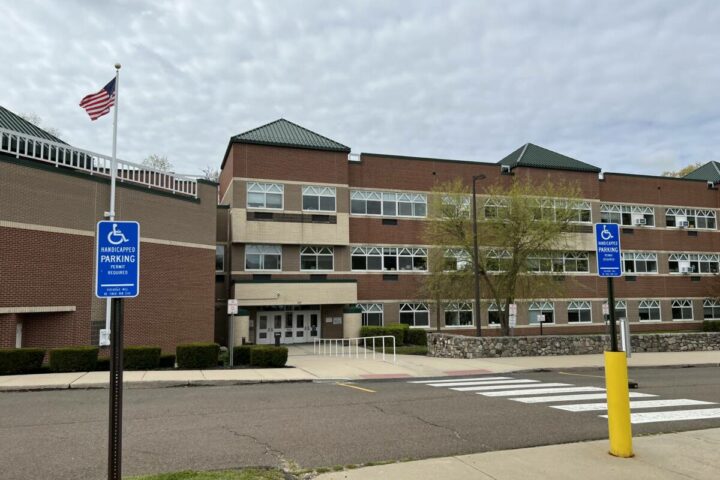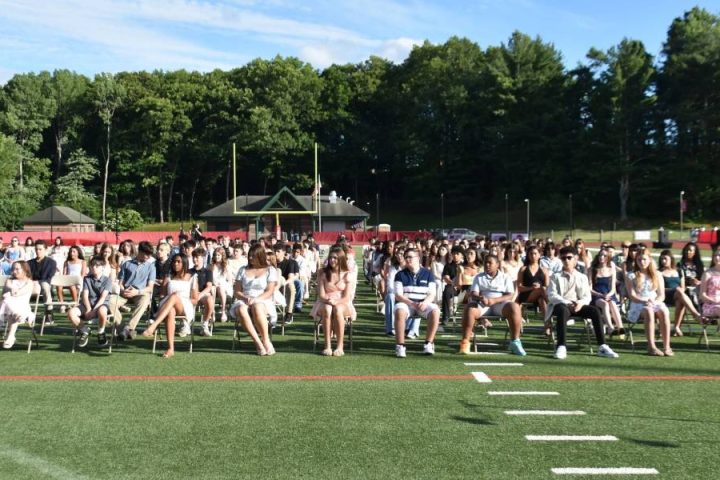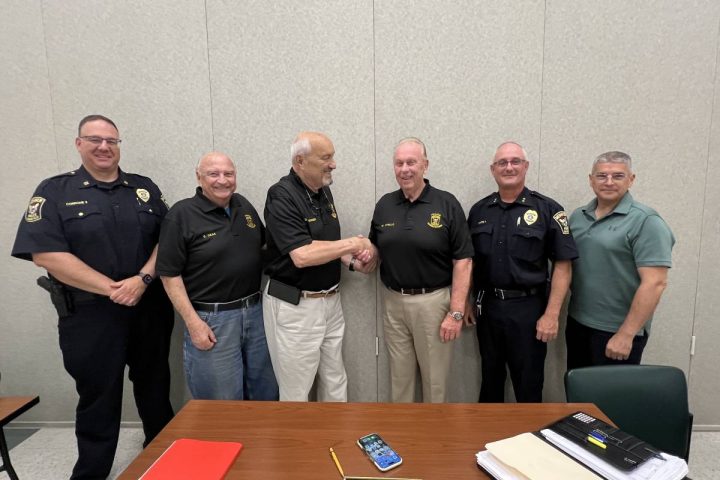
MONROE, Conn. — Reality Check, a financial household budgeting simulation, is now in its fifth year at Masuk High School. On Thursday morning, students from personal finance teachers Jonelle DiSette and Allyson Danso’s classes visited booths in the gymnasium, where volunteers offered life’s necessities like housing, food and transportation, along with wants like nightlife, vacations and TVs.
Each student had to use a paycheck from their chosen profession with the goal of either breaking even or having money left over at the end of the month. Falling short could mean picking up a part-time job as a side hustle.
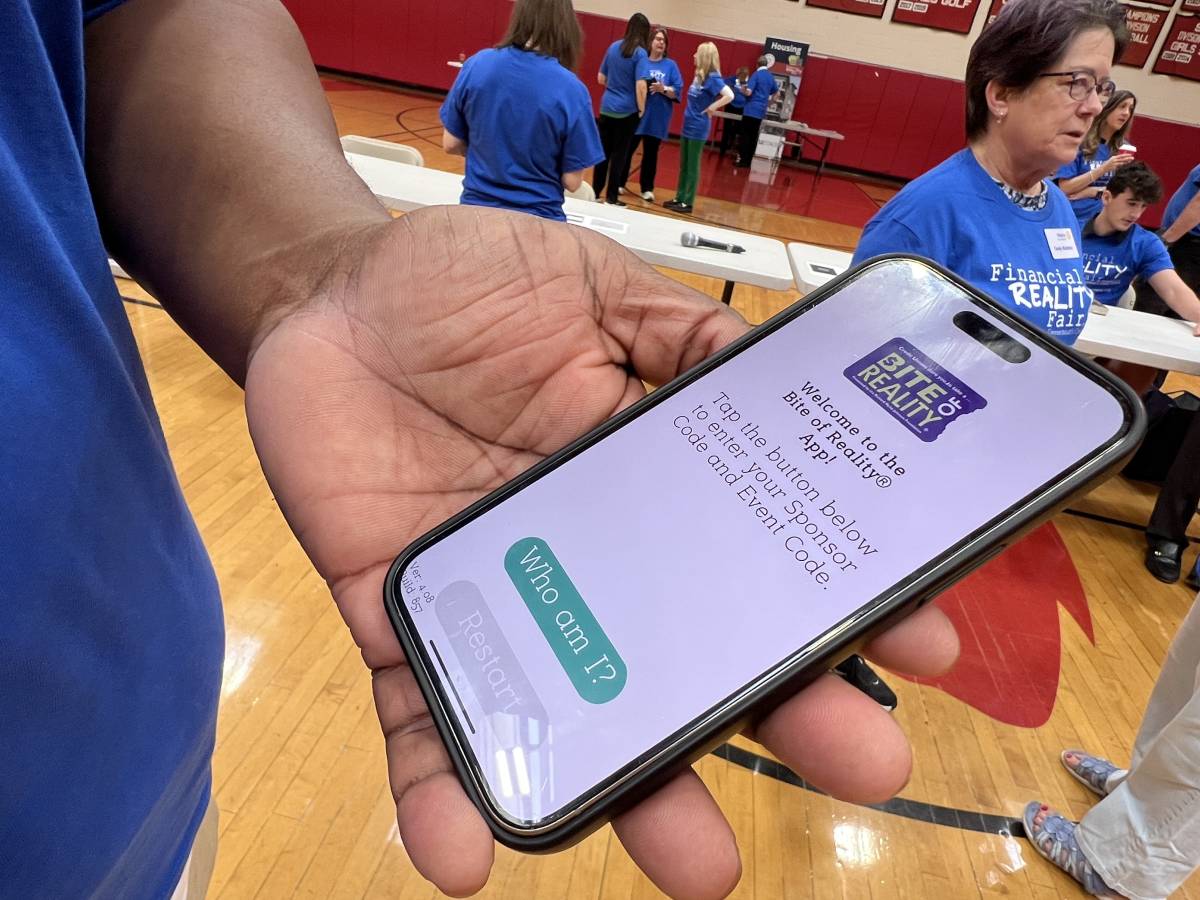
One new wrinkle in the Rotary Club of Monroe’s program was students use of a cellphone app provided by Connex Credit Union, which has a branch on Main Street, to track their purchases. The financial institution also provided information on costs of living.
Monroe Rotary President Ken Kellogg recalled how everything for Reality Check was tracked on paper, then on a Google Spreadsheet before the app.
Superintendent Joseph Kobza, who is also a Rotarian, said, “it’s good that they’ll have all the information on their phone as they go through a month of expenses.”
Kellogg said students enter codes for their purchases and the app calculates the impact on their bank balance.
Lee DuPree, AVP of community development for Connex, participated in the event. Connex representatives showed classes how to use the app in the cafeteria upstairs before students came down to the gym in two waves.
DuPree said Connecticut’s Credit Unions offers the app, which was created in California, for union members, such as Connex, to use in programs like Reality Check. He said Connex has been involved in the program at Trumbull High School for two years, and he had met Monroe’s superintendent there, when Kobza was serving as a volunteer. This led to Masuk using the app this year.
“You put in a code with each sale on the phone and at the end you have a nice chart,” DuPree said, while showing how the app works on his cellphone.
After participating in Reality Check, DuPree said Masuk students had the opportunity to talk to financial counselors from Connex about credit and budgeting.
“Connecting with the youth and planting that seed is important for our mission and values, because these students are the next wave of members,” DuPree said of Connex’s involvement with Reality Check. “It’s more important now.”
Reality Check runs on volunteers
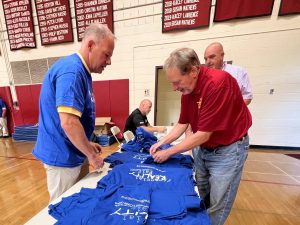
Piles of blue T-shirts were displayed at a table for volunteers when they entered the gym from the rear parking lot and boxes of Dunkin’ Donuts coffee and munchkins were available on the far side of the room. The adult volunteers are needed to work at booths, while helping students choose among different options for things like cars, housing and furniture.
“A huge thank you,” Kellogg said to the group before the first students arrived for the program. “Thank you for taking time out of your day to help these students.”
He also credited David Wolfe, a Rotarian who first brought the idea for Reality Check to the Monroe Rotary Club five years ago, patterning it after a program at the Yukon Public Schools in Oklahoma. Connecticut has since made teaching personal finance a mandate in high schools to promote financial literacy.
Kellogg said the Rotary Club is all about service. Of Reality Check, he said, “this is what we’re all about.” Volunteers who are not members were encouraged to check out fliers on how to join the Rotary Club of Monroe.
Among the volunteers was Lydia Struzik, who sat at the furniture booth.
“Furniture is where my husband and I got in trouble,” Struzik said of her own life experience. “We bought all our furniture and realized we couldn’t afford it. We put it on our credit card and the interest rates were so high, we couldn’t catch up. My mother bailed us out. I wish they had this program when I was in high school.”
Roommates share expenses
Masuk juniors Melanie Ledee, 16, and Adriana Lupo, 16, decided to share a two-bedroom apartment to make their dollars stretch. Lupo chose to be a nurse and Ledee an architect.
At the food booth, volunteer Tom Sheehy showed the students options to eat at home every day for 30 days at $1.50 per meal; to bring lunch from home Monday through Friday at $2.50 per meal and weekends at three dollars per meal; or a more expensive option of eating dinner at home 28 days a month at $4.50 a meal and eating out two days a month at $12 per meal.
“That one!” Ledee said of the cheapest option. “We’re not wealthy enough for that!”
When they shopped for furniture, Lupo and Ledee were able to share the cost of a kitchen table, a chair and a sofa, but bore their own costs for queen beds.
“What’s the cheapest option?” Ledee asked at the transportation booth.
“When you pick a car, pay attention to your credit score and gas,” said Shaunelle Leslie, a volunteer.
At the cellphone table, Walt Pirog asked the students if they wanted an Apple or an Android. “In real life you can play them off each other and say, ‘I’m a student and Verizon is lower,” Pirog said.
Despite not choosing the most extravagant options, both Lupo and Ledee found their bank accounts falling rapidly, so they decided to get side hustles to make ends meet.
Lawren Hubal, a volunteer, told Lupo how working night or day shifts as a nurse would leave her time for a part-time job. After reviewing the options, Lupo chose to pick up a job as a waitress for 40 hours a month.
“Now I have $1,029,” Lupo said of the extra $400.
Ledee took a job as a store clerk, but then got hit with a random $240 expense.
Reality Check used to have a feature called the Wheel of (Mis)Fortune to mimic the unpredictable scenarios life throws at you despite your careful financial planning. Every student had to take one spin for the chance to come into money due to an unforeseen circumstance such as an inheritance, or to pay an unexpected expense for something like a car repair.
Now there is no wheel. Instead, random events are built into the phone app.
Lupo and Ledee bought clothing for work, then went to a booth called Lifestyle and Self-Care.
“You have to get a haircut,” Kellogg said. “The rest is optional if you want to go to a gym or you want to get a pet.”
“Pets, maybe if I have money at the end I’ll come back,” Ledee said, adding she would probably get a ferret. “Honestly, it looks like a cute little pet.”
Carrie Milks, a volunteer at the Technology table, said they were told to encourage students to spend more money. “We’re sales people,” she said of their role. Ledee and Lupo decided to get Netflix as a streaming service, rather than cable, but volunteer, Andrew Jimenez got them to splurge a little.
“You’ll definitely need a TV,” he said. “The biggest one, right?”
The students sprung for the 65-inch screen and also wanted an X-Box, but were not allowed to make another purchase in the simulation.
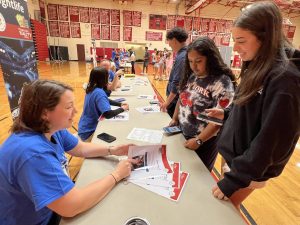
At the Nightlife booth, volunteer Kathleen Riley enthusiastically promoted concerts, cruises and vacations. “Have fun! Meet people,” Riley exclaimed, before enticing Ledee to commit to a package with a European vacation.
“Yeah, she’s living it up,” Riley said. “All the other kids will be at home and you’ll have all these friends.”
Lupo decided to spend her money on concert tickets.
When all was said and done, Lupo finished the month with $83 and Ledee had $358 left.
“When living with multiple people stuff is cheaper,” Lupo said of the experience.
“I couldn’t think of living alone. That would be hard,” Ledee agreed, adding, “the cars are expensive. We got Uber, a cheaper option.”
Paying their own way
Masuk Principal Steve Swensen said he likes Reality Check, because it gives students perspective on how much things cost, because currently their parents buy so much for them. “For example, they don’t know how much it costs for Uber Eats, because it’s connected to their parents’ card,” he said.
When students are on their own and want something, like an internet streaming service, Swensen said they will have to buy it themselves.
“Sometimes choices are hard,” Swensen said. “Do you need a part-time job to make ends meet? I think it’s valuable lessons. A lot of kids come out with money left over, but I wonder if they got what they wanted.”
“I love this evolution of it,” finance teacher, Jonelle DiSette, said of the first five years of the Reality Check program. “I love everything they need to do to keep and balance a budget. It’s all on the app. It’s very organized. The first two years everything was on paper. Then two years on their laptops.”
DiSette said internet service in the gym is not ideal. “I think the app solves that issue,” she said. “I really do love that our Rotary members are still able to participate. I love the insights that they share with the students.”
For example, she said one student wanted to ride a bicycle for his transportation. But DiSette said a volunteer asked him, “what if it snows?” and what if he wants to travel outside of Monroe?
“He chose a bus,” DiSette said of the student.
Among the volunteers was David Wolfe, the Rotary member who started Reality Check five years ago.
“I think it’s a great opportunity for the kids,” he said. “It changed in terms of technology and the ways it’s run, but we hope kids will still get the financial reality. The goal is to bring a little financial reality to the students.”
All respectful comments with the commenter’s first and last name are welcome.