

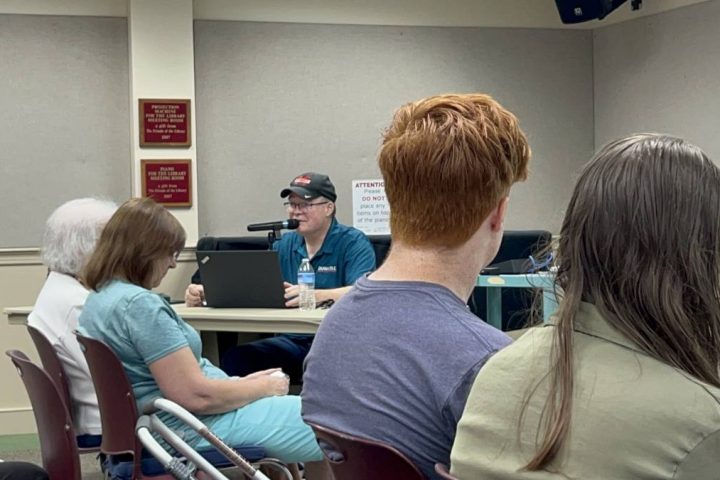
MONROE, CT — During a public hearing last Thursday, Mark Lamont, of Downs Road, expressed his agreement with Planning and Zoning Commission Chairman Michael O’Reilly’s stance of maintaining the town’s “rural/suburban atmosphere” when it comes to development.
But Lamont, who opposes a proposal for Sun Valley Glen, asked how the eight lot cluster housing subdivision, planned for a 30-acre-parcel at 1536 and 1564 Monroe Turnpike, which currently provides a “wonderful habitat for wildlife,” protects Monroe’s rural character.
“It’s going to be developed,” O’Reilly said. “It’s private property. To me, it makes more sense to leave more of the property wild and undeveloped. Someone could come in and say, ‘I’m going to develop the whole thing.'”
Cluster housing allows developers to build housing units closer together and on smaller lots, leaving more open space that is preserved in perpetuity.
“We can’t stop private owners from developing their land. It’s America,” O’Reilly said. “It’s going to be developed — ‘which way do you want it to be developed?'”
“If what you said is true, what’s the sense of the hearing?” Lamont asked.
“To make sure it stays within the rules, is safe for properties around it and to reduce the impact,” O’Reilly said.
Lamont asked about the potential impact on the endangered red-tailed hawk.
“We can ask them to make some changes,” O’Reilly said of the application.
The Monroe Planning and Zoning Commission cited concerns over wells in the Stevenson area as a reason for its denial of Sun Valley Glen last May, finding the applicant did not provide sufficient hydrogeological evidence or data to show wells for the new dwelling units would not negatively impact existing water sources.
But on Sept. 4, the commission unanimously decided to allow the developer to resubmit the plan again without changes after commissioners agreed a well analysis done by a hydrogeologist hired by the applicant makes the proposal “substantially different” enough, not to require a new proposal.
Other than the well analysis, Christopher Russo, the attorney for the applicant, said the latest application is essentially the same as the last one.
Meanwhile, there is a pending lawsuit filed by the applicant, Jans Land Development LLC, appealing last May’s denial. The legal action was filed at the Superior Court in Bridgeport on May 21, 2025.
Last Thursday, the commission started the new hearing, which was continued to Oct. 16.
Planning and Zoning Administrator Kathleen Gallagher had recommended that the hearing be kept open to allow commissioners time to read hundreds of pages of letters that were submitted into the record.
During the hearing, Russo said cluster housing offers an opportunity for flexibility, but does not permit more lots than a regular subdivision.
If the same number of lots and wells were approved in a regular subdivision, Russo said only 15 percent of the land would have to be preserved as open space. In the current proposal, Russo said over 57 percent of the property would be preserved as open space.
Russo said the commission is controlled by its regulations and commissioners cannot consider offsite traffic conditions, municipal services or surrounding property values.
“If it meets the regulations, a commission has to approve it,” Russo said. “We just feel this is a better option for everybody in preserving this open space, rather than a conventional subdivision.”
The attorney said the proposal greatly exceeds the regulations’ standards. For example, he said 34 percent of a parcel must be preserved as open space in a cluster housing development and his client is proposing 57.8 percent.
After consultations with the Connecticut Department of Transportation, Russo said Sun Valley Drive, the driveway entrance for the housing, would be located across from Old Zoar Road.
He said the development would have a good buffer between wetlands and neighboring homes, along with a drainage plan.
A swale was added to the plan to protect a the property of Paula Jelly, a neighbor living on Cottage Street.
Impact on wells
The developer hired Jody Tuttle of Howard Tuttle & Sons, an Oxford based company that has drilled many wells in the area, including in Monroe.
Karen DeStefanis, vice president of WSP, an engineering firm in Shelton, gave a presentation on the aquifer and the wells to the commission. DeStefanis is a hydrogeologist and a certified professional geologist with over 35 years of experience in her field.
She said sand and gravel are great for wells with typical great yields, but the Monroe property has clay, silt, sand, gravel and boulder. “It’s a mix. It’s not likely to have a reliable well,” DeStefanis said.
Tuttle said seams will be drilled into the bedrock. When a well is drilled deep enough, it could get about 500 gallons of storage. He said his company typically drills wells between 200 and 300 feet deep.
Russo said wells are now dug deeper, because storage is required.
“It’s really seams in the bedrock,” Tuttle said. “It’s not like everybody taps into the same aquifer. There are so many seams, it’s not common to hit the same seam someone else is using.”
If that happens, Tuttle said the homeowner’s well water gets dirty, so his crew knows they tapped into someone else’s seam.
“About 99 percent of the time we get a good well,” he said.
DeStefanis said she tries to determine whether a project’s demand for water is supported by the recharge.
She said half of rainwater is lost to evaporation, while the other half goes to surface runoff and groundwater recharge. DeStefanis said 85 percent of all waste water — from dishwater and a septic system — goes back into the system.
DeStefanis said she subtracts the demand from the recharge to determine if there is a deficit or a surplus.
When calculating demand and estimated recharge, said she came up with a surplus 12,230 gallons per day. In a calculation with consumptive demand, she ended with a 15,800 gallons per day surplus.
Commissioner Ryan Condon asked if city water was considered and the applicants said the property is too far away to hook up to an existing water line.
DeStefanis said she used available well records from the Metropolitan Council of Governments (MetroCOG) database and Monroe Health Department records in her review of existing wells in the area.
She said it is her opinion that any impact on the recharge of neighboring wells would be “indecernable.”
Nicole Lupo, a commission alternate, said she is concerned over whether properties at the top of the hill in Stevenson will lose water that is pulled to the Sun Valley Glen wells.
There are no maps of these wells at Monroe Town Hall to review.
Vice Chairman Bruno Maini asked DeStefanis if she was saying the eight new wells would not affect the wells around it.
“I’m saying it’s a low probability,” she said. “Not having a physical well to test, I would say the probability is less than five percent.”
Drainage
Aside from there being enough water for all of the wells, Condon said the commission is concerned about properties getting too much water from runoff.
J. Edwards & Associates’ stormwater drainage plan has detention basins and is meant to capture any excess runoff and treat it on the site. And Gallagher said the town’s regulations require a developer to collect and treat any excess stormwater runoff.
“I just think there will be substantial runoff from removing trees,” Maini said.
A swale is meant to capture water flowing down.
“Whatever goes in there, you believe the two-foot-wide swale is enough to protect the Cottage Street property?” Maini asked the applicant.
A representative of J. Edwards & Associates said he does.
Condon asked about sidewalks and Russo said no sidewalks are proposed.
The applicant is requesting:
- A waiver allowing for the reduction of pavement width of 32 to 28 feet for the entrance road.
- A waiver of the requirement of reinforced concrete pipe for the stormwater system, instead using a drainage network built with high-density polyethylene pipe, known for its durability, corrosion resistance, smooth interior for efficient flow.
- Another waiver is being sought for the requirement for a four-foot shelf to be installed on each side of a box culvert crossing.
The sharp-shinned hawk
Michele Soltiesiak, of Cottage Street, expressed concern over the recharging of her well, and disbelief of the assumption that 85 percent of withdrawn groundwater will return to the system.
“I’m really concerned that more than half of the well data is missing, at no fault to the applicant,” Soltiesiak said.
She said there are too many numbers that don’t make sense in the well analysis, making it hard to trust everything. Soltiesiak also said the town should hire its own expert to run an independent test.
“I can’t afford to dig a new well,” she said. “My taxes just went up $1,000.”
Lamont also expressed concern over the potential of area wells going dry.
Jelly said she learned the hard way not to water her lawn, while living with her well. She added that she does not wash her car or run her washing machine and dishwasher at the same time.
The hill behind her house is steep, so she said she let her property go wild with trees and underbrush to absorb water that flows down.
“The storm last year just overwhelmed it,” Jelly said.
Jelly said she submitted a Freedom of Information request seeking proof the applicant spoke with the DOT on the location of the access road to the developer’s property, and she said a sight line analysis needs to be done to ensure safety in the neighborhood.
Should this application be approved, Jelly questioned the construction schedule and how it would disrupt the neighborhood with noise.
Brian Theoret, of Sunrise Terrace, called the application “grossly inadequate,” adding his primary concern is a threat to the water supply.
“I urge the commission to deny the application until there are independent, comprehensive studies showing this would not negatively impact wells,” Theoret said.
He questioned how the swale would protect Jelly’s property and said the proposal involves an extensive wetlands disturbance in the area.
Theoret also said the location of the proposed driveway is dangerous with the traffic along Route 111.
“I prefer they are held to the same standards of previous developments,” he said of having sidewalks.
Theoret’s wife, Samantha, said, “when it was denied, I was happy. Now they’re back and we’re being sued. I don’t think the neighbors expect it will never be developed.”
She said most of the open space the developer would give to the town consists of wetlands and other unbuildable land.
Theoret also said the four-to-five bedrooms proposed are not consistent with many other two and three bedroom homes in the area.
“We just want it to be done the right way,” she said of development in the area. “That’s why we’ve gone at it so long. We’re very passionate.”
Kelley Hangos-Carrano, of Scholz Road, suggested giving no waivers or variances for cluster homes and requiring public water. She also contended the area cannot support the eight new homes, wells and a fire pond.
Hangos-Carrano said fracking is a concern.
“The Sierra Club and DEEP have been contacted about this property, because we feel we’re spinning our wheels,” she said. “We realize it will be developed, but let’s be real, eight homes are too much.”
Jelly said she saw a sharp-shinned hawk and took a photo of it on Aug. 11, adding the Connecticut Department of Energy and Environmental Protection confirmed it was the endangered bird and said it would add the information to its database.
“Please protect this bird,” Jelly said.
Closing
Gallagher said the town allows construction to be done from 7 a.m. to 5 p.m. Monday through Saturday and developers cannot have work done on holidays, and noisy work like excavation is permitted from 8 a.m. to 5 p.m Monday to Friday.
But she said the commission has made restrictions for applications in the past.
Gallagher also said she will push for a sight line analysis at the proposed driveway for Sun Valley Glen.
In their final statements Thursday, DeStefanis defended her 85 percent recharge number, saying it came from studies.
Russo said an encroachment permit from DOT is required, so Jason Edwards reached out to the state agency for that. The DOT will have to approve the road, he added.
Russo said his client’s proposal represents “smart development” with standards that protect the things neighbors care about. “That’s what I think this development does,” he said. “It will preserve open space in perpetuity, protecting that area forever.”
Russo said a portion of land that Dr. Michael W. Klemens, the environmental consultant hired by the town during the last hearing, identified as important for the area’s ecology, is included in the acreage to be preserved in the proposal.
All respectful comments with the commenter’s first and last name are welcome.



I’m a little concerned about the statements made by Mr. Russo concerning our obligation to approve any construction project that meets the regulations. I thought I’d off a little history lesson. Back in the 70’s and 80’s, Dan Tuba was the Town Planner. He has been blamed for all the issues associated with the appearance of Rt 25. While it looks a little better now, it still leaves a lousy impression for people traveling through town. The problems were blamed on the lack of a comprehensive town plan for development. Apparently, this was all his fault. So do we have a town plan now? Does it specify how we want to see this town developed? There doesn’t seem to be any attempt to develop a consistent look to what’s being built on Rt 111.
Stop telling us that developers can build anything they want if they own the properties. Find out how other towns control this and make it happen here before it’s too late.