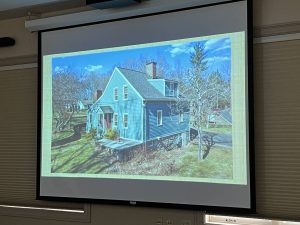
MONROE, Conn. — Kevin Daly remembers his school bus driving past the historic Bailey House at 150 Old Tannery Road in the 1970s, when he was a student at Chalk Hill Middle School. A single headstone in the backyard caught his eye.
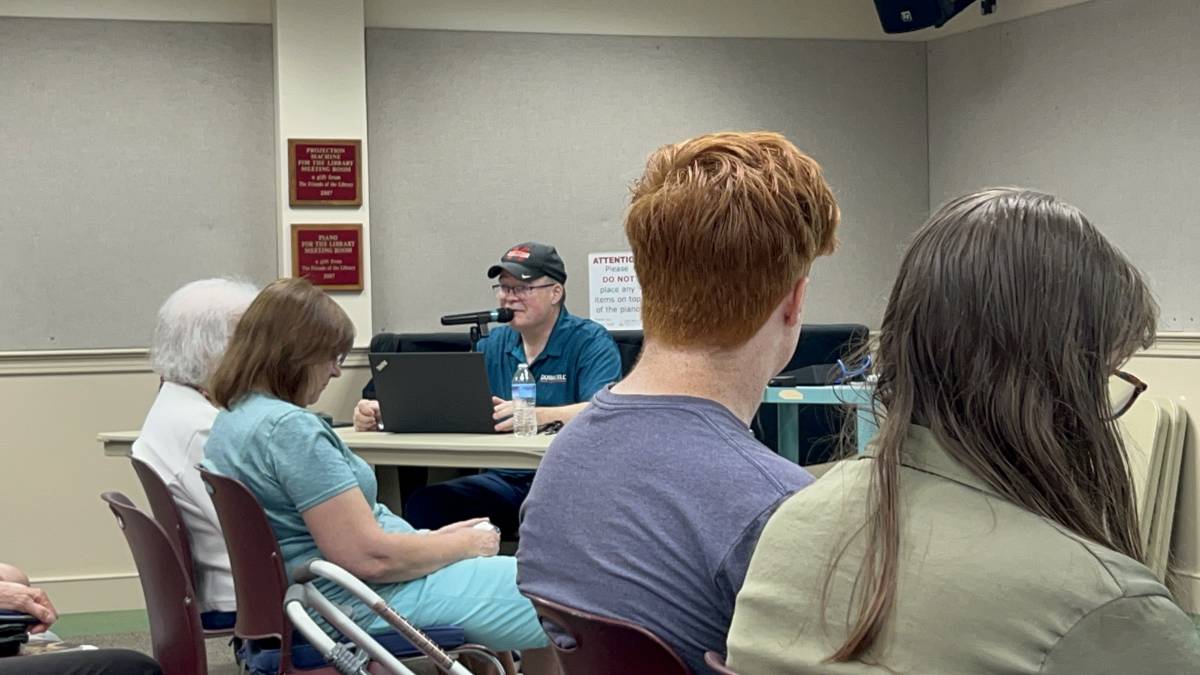
“I got chills up my spine that someone could be buried in someone’s backyard,” Daly, the historian for the Monroe Historical Society told his audience during a lecture in the Ehler’s Room of Edith Wheeler Memorial Library last Thursday evening.
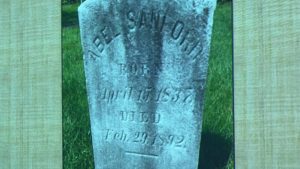
The headstone of Abel Sanford, who was born on April 15, 1837 and died on February 29, 1892 at age 55, was placed on the Bailey property decades ago, because it was believed to be the site of Monroe Center’s first burial ground.
Daly said Sanford had a difficult life. He was severely disabled, had mental disabilities and could not live on his own. His family owned a foundry, but he still needed more than his family could provide, according to Daly.
From his knowledge of historic families in the area, Daly knew Sanford was an Easton and Redding name. He called first selectmen in both towns and learned the headstone had gone missing. It was later returned to the Sanford Family Cemetery on Sport Hill Road in Redding, where his stone was reunited with his relatives’ plots.
After the stone was removed, the yard behind the Bailey house was excavated for an unrelated reason, but Daly said it uncovered no evidence of a burial ground, so it had to have been located somewhere else in town.
This sparked his investigation of the Peppercorn Lease, which Joseph Moss (Morse) signed to allow use of a half acre for the
burial ground in 1765. The lease was the topic of Daly’s lecture, part of a series sponsored by the Monroe CT 250 Committee, the Monroe Historical Society, and Edith Wheeler Memorial Library.
“It all started with a simple inquiry of a stone in someone’s backyard,” Daly said.
Daly teamed up with Gary Thompson, interim historian for Monroe Congregational Church, to pore over the Peppercorn Lease and the church’s old records to try to nail down the exact location of the burial ground.
Knowing the terms
Joseph Moss (Morse) donated a half acre of land at Brushy Ring on May 29, 1765, when Monroe was still a part of New Stratford and Connecticut was a colony under English rule.
In May of 1762 the General Assembly of the Governor and the Company of His Majesty’s Colony of Connecticut (King George III) approved the establishment of a distinct “Ecclesiastical Society” in “New Stratford,” Daly said of the New Stratford Ecclesiastical Society that leased the property for the cemetery.
The Peppercorn Lease uses Old English terms, such as rods for measurement, and calls the parcel Brushy Ring, which is near a stony slough, 10 rods from north to south and eight rods from east to west, “and ye Same is bounded East, West, North And South on my land beginning at a Small Rock by ye Spring …”
It says it is two rods west of the highway, running westwardly eight rods to a heap of stones, and southwardly 10 rods to small rock stones then eastwardly eight rods to “a Rock Stones on it then northwardly …”
One of the first steps in interpreting the historic document is knowing the meanings of the Old English terms, according to Daly.
He said a peppercorn lease is a contract, in which a lease is reduced to such a low amount, sometimes to an actual peppercorn a year, when the landlord does not want to charge a real rent.
In Old English measurements a rod is five-and-a-half yards or 16-and-a-half feet.
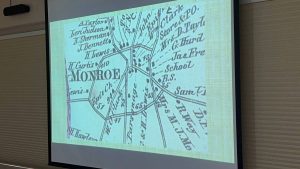 The Brushy Ring is not the Monroe Green, according to Daly, it is the greater circuit of roads that define Monroe Center (Church Street, Abbey Lane, Shelton Road, Old Tannery Road, Wheeler Road).
The word “slough” is spelled “Slow” in the lease and it is pronounced “slew,” Daly said, adding it refers to “a swamp, marsh, bog, or a shallow, slow-moving backwater, typically found along the edges of rivers.”
If early settlers were placed on the Monroe Green today, Daly raised the question of whether they would know where they were. Though they may marvel at the houses and churches that hadn’t been built during their time, Daly said Monroe’s topography has not changed.
He used LiDAR (Light Detection and Ranging) technology to see the contours of the land in an effort to find terrain matching the description in the Peppercorn Lease.
Daly was looking for land by a stony swamp and a brushy knoll.
Charity Wheeler
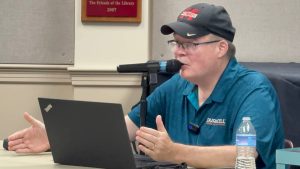
Through his research, Daly said he had only found documentation for one person who was buried in the old cemetery, Charity Wheeler, who died in 1780. She was married to Nathan Wheeler and the couple had three children, according to a short newspaper article Daly showed his audience.
Of the cemetery, the article said, “her internment was one of the last made there; and though her grave and indeed the graveyard have since disappeared, a fragment of her headstone was for a long time to be seen in an adjacent stone wall.”
While searching for the old burial ground, Daly’s research led him to a private property on Church Street, across from the driveway for St. Jude, which has a knoll in the woods behind the house.
“Is this the location of Monroe’s original burial ground?” Daly asked, before noting its features meet the details of the Peppercorn Lease.
He would need permission from the homeowner to go onto the property for a closer examination. If Daly is ever able to go there, he said he may not look for headstones as defined as Abel Sanford’s, which could still be read. Rather he would look for stones in a row.
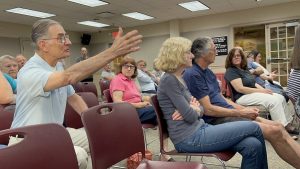
During a question and answer period, someone asked Daly if coffins could still be found or if evidence of coffins would have disappeared by now.
Back then, Daly said it was not uncommon to bury someone without a coffin. However, he said anytime the ground is disturbed, ground penetrating radar could find anomalies showing something was there.
Though he concedes there is no “smoking gun” yet, from his findings, Daly said, “I believe Monroe Center’s original burial ground is located somewhere west of the Monroe Green.”
All respectful comments with the commenter’s first and last name are welcome.